Posts Tagged With: birds

FEATHERY FRIDAY #5

FEATHERY FRIDAY#5

We’re very excited about today’s Feathery Friday! This bird is known to be very smart and great at imitating human speech. Wonder if they can do a good elephant or horse impression? Let’s meet today’s fabulous feathery friend…

MEET THE AFRICAN GREY PARROT!
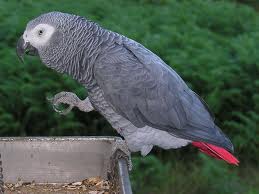
Range/Habitat: West-Central Africa/lowland rainforest and farmland

Diet: Herbivore: fruit, nuts, leaves

Length/Weight: 13”/14 oz

Conservation Status: Common- Near Threatened

Fun Facts:

  • African Grey Parrots are highly social birds that live in flocks.
  • There are two subspecies (types) of African grey parrots: the Congo, who is larger and has a bright red tail and the Timneh, who is smaller and darker and has a maroon tail.
  • When flying in large flocks African greys call to each other and communicate by flashing their bright red tails.
  • They have a long life span. They can live up to 60+ years.
  • They are highly intelligent and have been compared to human toddlers.
  • African greys are highly vocal and are amazing at mimicking sounds and language!
  • Alex is an African Grey Parrot that worked with Dr Irene Pepperberg and was known to do things such as sort colors, shapes and count! We’re going to write a separate post about Alex- he was a very special bird!

African grey parrots are very special birds! They’re very smart and social, a great combination! If you could teach a parrot to say one thing, what would it be? Ellie would teach him to trumpet like her!


Categories: Animals, birds, Children, education, Environment | Tags: , , , , | Leave a comment

FEATHERY FRIDAY #4

FEATHERY FRIDAY#4

It’s FRIDAY and we have another great Feathery friend for you to meet today! As summer wraps up here, we’re dreaming of cooler temperatures and today’s bird loves the cold! Is it a penguin? Nope this bird lives in the Northern Hemisphere…

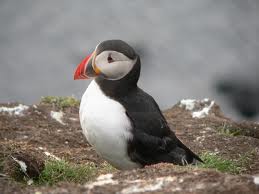
MEET THE ATLANTIC PUFFIN!

Range/Habitat: North Atlantic and Arctic Oceans from Northern Europe-Iceleand-Newfoundland / ocean and rocky coasts

Diet:  Carnivore: fish, mollusks, crustaceans

Length/Weight: 11-12”/ 1 lb

Conservation Status: Common

Fun Facts:

  • The Atlantic Puffin is a highly social bird that lives in large colonies on rocky coasts and islands.
  • They have bright orange beaks that are brighter during mating season. They also have bright orange feet. They’ve been called the “sea parrot” because of their bright coloration.
  • Male and female Atlantic Puffins incubate eggs.
  • Atlantic Puffins spend their winters out in the open ocean.
  • They are excellent swimmers and divers. They can dive up to 200 ft deep.
  • Atlantic Puffins can fly unlike penguins.
  • They can catch several fish at one time.
  • Atlantic Puffins are the Provincial (official) bird of Newfoundland, Canada.


Atlantic Puffins sure are snappy looking birds with their bright orange beaks and feet! And they can fly and swim! We wish we could fly and swim!


Categories: Animals, birds, Children, education, Environment | Tags: , , , , | Leave a comment

FEATHERY FRIDAY #3

FEATHERY FRIDAY#3

We’ve made it to another Fabulous Feathery Friday! And you’ll need to put on your glasses to see this tiny little Bee…

MEET THE BEE HUMINGBIRD!

Range/Habitat: Cuba

Diet:  Omnivore: nectar and tiny insects

Length/Weight: 2 ¼“ / 1/16 oz (about the weight of a penny)

Conservation Status: Near Threatened

Fun facts:

  • The Bee Hummingbird is the smallest bird in the world! It weighs about as much as a penny.
  • It has a long tube-like tongue it uses to suck in nectar from flowers.
  • Male Bee Hummingbird’s heads are iridescent (kind of like glitter), the females are not.
  • They can beat their wings at 80x per second. It is so fast that it can’t be seen by the human eye! (It can’t be seen by the elephant or horse eye either.) 😦
  • They are just barely larger than a bee.
  • Bee Hummingbird nests are only about 1” in diameter (just slightly larger than a quarter).
  • Bee Hummingbird eggs are about the size of a pea.

This teeny tiny bird has made our Feathery Friday! We’d loved to see one and their eggs; pretty sure we’ll need to use our magnifying glass!

Categories: Animals, Children, education, Environment | Tags: , , , , | Leave a comment

Blog at WordPress.com.

