Animals

REPTILIAN TUESDAY # 8

REPTILIAN TUESDAY# 8

Who’s excited to meet another reptile on this Reptilian Tuesday? We definitely are and we have a great tortoise for you today! Tortoises may be slow but they sure are awesome! Besides who won that race with the hare? Let’s meet this great animal…

MEET THE RED FOOTED TORTOISE!
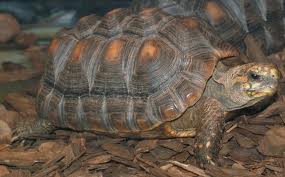
Range/Habitat: North-Central South America/forest edges, savannas, grasslands

Diet: Herbivore: leaves, flowers, plants and the occasional bug

Length/Weight: 16-20”/up to 25 lbs

Conservation Status: Endangered


Fun Facts:

  • Red Footed Tortoises have red- yellowish spots on their legs and their scutes. Scutes are the coverings on turtles and tortoise shells; they are made up of keratin, the same protein that makes up your nails and hair.
  • They can live up to 50 years.
  • Male red footed tortoises are smaller around the mid-section; it looks like they have a waist. If you look at them from above they have an hourglass shape.
  • Female red footed tortoises lay eggs. They can lay up to 15 eggs per clutch.


Red footed tortoises are really neat! They are popular to keep as pets. Would you like a tortoise as a pet? You have to do your homework and learn how to take care of them. Exotic pets, like tortoises and snakes need special habitats, food and care. We met a red footed tortoise at Zoo Atlanta who’s shell was misshapen and heavy because his owner fed him dog food. It’s really important to know how to take care of your pet!


Categories: Animals, Children, education, Environment, reptiles | Tags: , , , , | Leave a comment

MAMMAL MONDAY # 9

MAMMAL MONDAY# 9

Wow, it’s Monday again? Where did the weekend go? We have a great mammal for you today! This special mammal could have been featured on Watery Wednesday, but we just couldn’t wait for you to meet this animal, so let’s do it!

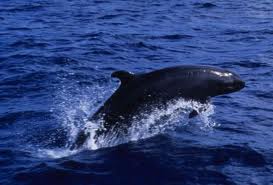
MEET THE FALSE KILLER WHALE!

Range/Habitat: worldwide/temperate-tropical waters

Diet: Carnivores: salmon, tuna, barracuda

Length/Weight: 16-20ft/1- ½ tons

Conservation Status: lower risk


Fun Facts:

  • False Killer Whales are one of the largest members of the dolphin family.
  • They are agile and fast swimmers.
  • False killer whales get their name because they resemble Orcas (aka Killer Whales).
  • They don’t have a beak (like a bottlenose dolphin).
  • You often see them swimming in groups of 10-20 whales. A group of whales is called a pod.
  • False killer whales prefer deep oceans, but can be seen in shallows near land.
  • They are very social and use clicks and whistles to communicate with each other.
  • Like other members of the dolphin family, they use echolocation to locate their prey.


These whales have a funny name, but they sure are cool. People communicate by talking, but these whales use clicks and whistles. We think everyone should try making up their own False Killer Whale language and practice making clicks and whistle sounds! We’re going to try today! Edmond thinks he’ll be better than Ellie at this challenge!


Categories: Animals, Children, education, Environment, mammals | Tags: , , , , | Leave a comment

FEATHERY FRIDAY # 8

FEATHERY FRIDAY # 8

Have you ever seen the cartoon where there’s a coyote and a roadrunner? Did you know that there are real roadrunners? Well they are real and they’re pretty cool! So let’s meet our feathery friend the…

MEET THE GREATER ROADRUNNER!

Range/Habitat: Southwestern United States-Northern Mexico/desert and scrub

Diet: Carnivore: lizards, snakes, scorpions and spiders

Length/Weight: 22”/12 oz

Conservation Status: Common


Fun Facts:

  • The Greater Roadrunner can fly but spends most of its time on the ground.
  • They can reach speeds of up to 18 mph! That is one fast bird.
  • Greater roadrunners generally walk/run to catch their prey.
  • They use their large beaks to attack prey.
  • They have long tails that they lay flat when running.
  • Greater roadrunners have black skin under their feathers. They expose the skin to the sun to absorb heat.

We all love watching the coyote roadrunner cartoons, but the real roadrunner is just as fun! They are fast and furious little birds. How fast can you run? You should try and be a roadrunner for the day!


Categories: Animals, birds, Children, education, Environment | Tags: , , , , | 4 Comments

SUPER SURPRISE # 8

SUPER SURPRISE THURSDAY # 8

Rise and shine for Super Surprise Thursday! We have a riddle for you this morning! What do you get when you cross a kangaroo, a squirrel and rabbit? You get this crazy animal!

MEET THE SPRINGHARE!

Range/Habitat: Central-East South Africa/dry savannah

Diet: Omnivore: seeds, bulbs, plants, insects

Length/Weight: 10 ½”-16”/6 ½-8lbs

Conservation Status: Common


Fun Facts:

  • Springhares are not actually hares (a relative of the rabbit). They are rodents.
  • Springhares have large long hind that are built for jumping.
  • They can jump up to 6 ½ ft in one single bound.
  • Springhares have long bushy tails that help them when jumping and give them support when they sit.
  • They have large front claws for digging burrows.
  • Springhares are nocturnal (active at night).

These adorable animals may look like a kangaroo and a squirrel and rabbit, but they’re none of these! These rodents are pretty fabulous and are great jumpers! Edmond says he’s a good jumper, but I don’t believe him! How far can you jump? You should go outside and practice jumping like a springhare!


Categories: Animals, Children, education, Environment, mammals | Tags: , , , , | Leave a comment

WATERY WEDNESDAY # 8

WATERY WEDNESDAY # 8

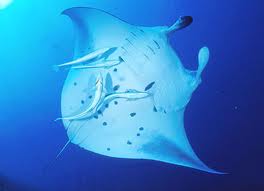
Wake up for Watery Wednesday! We have a gentle giant for you today! This big guy glides through the water looking for tiny, tiny animals to eat! So who this special fish? Let’s find out!

MEET THE MANTA RAY!

Range/Habitat: Worldwide/tropical-sub-tropical

Diet: Carnivore: plankton, small schooling fish

Length/Weight: 13-23ft/up to 1 ¾ tons (more than a small car)

Conservation Status: Near threatened

Fun Facts:

  • The Manta Ray is the largest ray in the world!
  • They filter plankton (tiny animals) out of the water. The water goes over their gills and special plates called gill rakers catch the plankton.
  • Manta rays can eat up to 60 lbs of food a day.
  • Manta rays are related to sharks. Their skeleton is made up of cartilage (the tissue in your ears and nose).
  • They have large lobes on the side of their head to help funnel the prey into their mouth.
  • Manta rays have no venomous barb on their tail like smaller rays.
  • They can jump out of the water (also called breaching). They often do this to avoid predators like sharks and killer whales.

Wow! Manta rays are amazing! They are such graceful and beautiful animals! We would love to go swimming in the ocean and meet one up close and personal! Too bad we don’t speak Manta ray J!

Categories: Animals, Children, education, Environment, fish | Tags: , , , , | Leave a comment

REPTILIAN TUESDAY # 8

REPTILIAN TUESDAY # 8

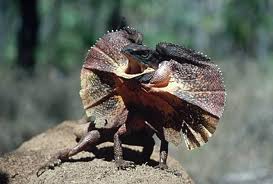
Man have we found an amazing reptile for today’s Reptilian Tuesday! Have you ever seen a lizard with umbrella shaped skin around its neck? We hadn’t either! It is one wild and crazy guy! Let’s meet…

MEET THE FRILLED LIZARD!

Range/Habitat: South New Guinea and North Australia/woodlands

Diet: Carnivore: insects, small vertebrates, arthropods

Length/Weight: 23 ½”- 32”/ 1 lb

Conservation Status: Common


Fun Facts:

  • Frilled lizards have a flap a skin around their necks. The frill has cartilage (the tissue that makes up your ears and nose) rods in it. It’s sort of like an umbrella around their neck.
  • The frill is brightly colored and can be 9 -14” wide when fully spread out.
  • Frilled lizards spread their frill out and hiss when threatened by a predator.
  • They are arboreal (live in the trees) and are great climbers.
  • When on the ground they can run on just two legs!
  • Frilled lizards are highly territorial.

Frilled lizards are crazy looking when they spread out their frills! But it is a fantastic adaptation to help protect themselves from predators! We would definitely stay away from a guy like that, wouldn’t you?

Check out this video from the BBC showing them running!

http://www.youtube.com/watch?v=utD66Z5Qb74


Categories: Animals, Children, education, Environment, reptiles | Tags: , , , , | Leave a comment

MAMMAL MONDAY # 8

MAMMAL MONDAY# 8

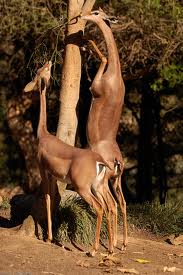
It’s Monday and we hope everyone had great weekend! Monday means it’s time to meet another mammal! Who’s excited? We are! This mammal has some very special adaptations to help them eat the leaves that others can’t! So let’s meet…

MEET THE GERENUK!

Range/Habitat: East Africa/dry and bushy scrub

Diet: Herbivore: leaves

Length/Weight: 4 ½ -5 ¼ ft/62-115 lb

Conservation Status: Near Threatened

Fun Facts:

  • Gerenuks are part of the antelope family.
  • They have long slender bodies, necks and small faces.
  • Gerenuks can curve their spines into an S shape, which enables them to stand on their hind legs.
  • Because they can stand on their hind legs, they can eat leaves that other animals can’t reach.
  • Gerenuks are also called the giraffe gazelle.
  • They have large ears and eyes that help them hear and see predators.
  • Only male gerenuks have horns.
  • They get all of their water supply from the leaves they eat, so they can survive in dry habitats.

Gerenuks are kind of funny looking with their long thin bodies and giant ears. We think it’s super cool that they can stand up on their hind legs to eat! What a neat adaptation!  They are called the giraffe gazelle, but they’re not related to the giraffe. Do you remember which antelope is? *answer below


*Okapi: ( http://wp.me/p1Gkpi-16 )

Categories: Animals, Children, education, Environment, mammals | Tags: , , , , | Leave a comment

FEATHERY FRIDAY # 7

FEATHERY FRIDAY #7

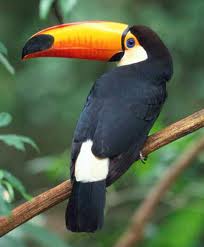
Whew! We’ve made it to another Friday and we’re so happy that it’s full of feathers! Our bird friends come in so many shape and sizes and today’s bird has a giant beak! Who is this amazing bird with the big ole beak?

MEET THE TOCO TOUCAN

Range/Habitat: North Eastern-Central South America (Bolivia-Peru-Argentina)/woodland, forest, groves

Diet: Omnivore: insects, fruits, frogs

Length/Weight: 21-23”/20 oz

Conservation Status: Common

Fun Facts:

  • Toco Toucans are the largest of all toucans.
  • They have large orange bills with a black spot. The bills can get up to 7 ½” long (about the length of a pencil).
  • Their bills are serrated (like a knife) and this helps them grasp and tear fruit.
  • Their large bills also enable the toucan to get fruit from out of reach branches.
  • Toco toucans nest in trees.
  • You can see Toco toucans in small flocks of up to 6 birds.
  • Both female and male toucans incubate the eggs.

Toco Toucans are really pretty birds with their shiny black feathers and large orange beaks! And man does that beak come in handy when you’re trying to get the fruit on the end of the branch! They also have a really cool call. Take a listen and Happy Feathery Friday!

http://www.youtube.com/watch?v=kgQggP7__-M

Categories: Animals, birds, Children, education, Environment | Tags: , , , , | Leave a comment

SUPER SURPRISE # 7

SUPER SURPRISE THURSDAY #7

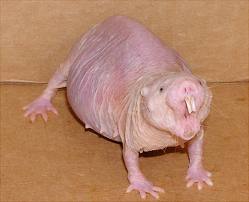
We didn’t have a Super Surprise animal last week because it was World Rhino Day! We hope you enjoyed learning all about rhinos on our Facebook page and our Twitter account!* Today’s animal is very special as it is naked mammal! Naked you say? Yep, it’s a naked animal. Let’s see who it is!

MEET THE NAKED MOLE RAT

Range/Habitat: East Africa/tropical grassland-deserts

Diet: Herbivores: roots-tubers

Length/Weight: 3-3 ½”/1- 2 oz (about as much as 4 to 5 quarters)

Conservation Status: Common


Fun Facts:

  • Naked Mole Rats are a very funny looking mammal. They are almost hairless, except for a few pale hairs and whiskers.
  • They are very social and live in colonies of up to 70-100 individuals.
  • Naked mole rats have a very unusual social structure. There is a queen naked mole rat and workers.
  • The queen is the dominant female and is the only naked mole rat to bread (have babies) in the colony.
  • Worker naked mole rats dig the elaborate tunnel systems that they live in. They also gather food.
  • Naked mole rats rarely surface from their underground tunnels.
  • They have tiny ears and eyes. They can’t hear or see well.
  • Naked mole rats have large teeth that they use for digging and eating.

We know naked mole rats aren’t the cutest animal on the planet; in fact they’re pretty bizarre looking! But even the bizarre animals are cool! Sometimes even more cool that the cute ones!


Categories: Animals, Children, education, Environment, mammals | Tags: , , , , | Leave a comment

WATERY WEDNESDAY # 7

WATERY WEDNESDAY #7

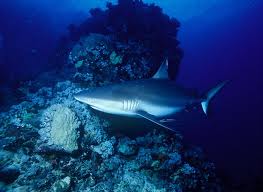
It’s Watery Wednesday and we have a shark for today’s animal! SHARK! Even though sharks get a bad rep, they are very important to the world’s oceans. So they deserve love and respect too, just maybe from a distance!

MEET THE BULL SHARK

Range/Habitat: Worldwide oceans/sub-tropical-tropical waters and some fresh water systems

Diet: Carnivore: fish, invertebrates, smaller sharks

Length/Weight: up to 11ft/500 lbs +

Conservation Status: Common

Fun Facts:

  • Bull sharks are one of the few sharks known to swim in rivers. They’ve been seen in the Mississippi, Hudson and Amazon rivers.
  • They have 5 gill slits, which they use to take oxygen from the water.
  • Bull sharks are large and stout. They’re named after the large and stout bull.
  • Adult bull sharks have no natural predators.
  • They have a bite force of 200lbs! Watch out for those teeth!

Bull sharks are amazing and powerful animals. You definitely don’t want to go swimming with one, but then again you wouldn’t want to walk up to a wild elephant either! These sharks are very important to our oceans! So let’s give a shout out to Bull Sharks!

Categories: Animals, Children, education, Environment, fish | Tags: , , , , | Leave a comment

Blog at WordPress.com.