education

WATERY WEDNESDAY # 6

WATERY WEDNESDAY #6

It’s another Watery Wednesday and we’ve found a very helpful little fish living in the coral reefs.  They love to eat things that are not good for other fish! What a great guy! Come meet the…

MEET THE CLEANER WRASSE!

Range/Habitat: Indo-pacific oceans/coral reefs
Diet: Carnivore: parasites and zooplankton (tiny small animals)

Length: up to 4 ½”

Conservation Status: Common

Fun Facts:

  • Cleaner Wrasse are very important part of a coral reef community.
  • They eat parasites off of other fish.
  • Cleaning stations are maintained by one to two fish (both females) or a male and two females. Other fish (also called “clients) come to the stations and have the wrasse eat the parasites.
  • You’ll often see the wrasse eating out of the mouths of other fish or out of the gills.
  • Cleaner wrasse sleep in rocks and crevices of the coral.

Can you imagine if you had to have a little fish help keep you clean while you took a bath? We bet it would probably tickle!

Categories: Animals, Children, education, Environment | Tags: , , , , | Leave a comment

REPTILIAN TUESDAY #6

REPTILIAN TUESDAY #6

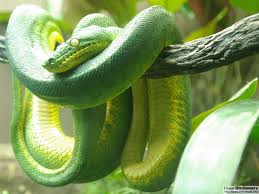
We’re loving trees this week! Yesterday’s mammal of the day was a Clouded leopard (they’re arboreal) and today’s reptile also lives in the trees. In fact tree is part of their name. Cool! So who is this super fabulous tree loving snake… Let’s find out!

MEET THE EMERALD TREE BOA!

Range/Habitat: Northern South America- Bolivia, Peru, Brazil/ rainforests

Diet: Carnivore: small mammals, birds

Length: 5-6 ½ ft

Conservation Status: Common

Fun Facts:

  • Emerald Tree Boas are an arboreal snake (they live in trees) and they have many adaptations to live in the trees.
  • Emerald tree boas are a bright green color and it helps them camouflage with the leaves of the trees.
  • They have prehensile tails. They can hang from their tails.
  • They curl around branches and rest during the day, because they are primarily nocturnal (active at night).
  • They will curl around branches and hang their heads lower than their bodies to lunge at prey.
  • Emerald Tree Boas are constrictors, meaning they squeeze their prey before swallowing them whole! They don’t have venom, but they do have long teeth to help grab their prey.
  • Emerald tree boas have special pits around their mouths to detect the heat given off by other animals. This heat sensing ability helps them tract prey.
  • Young Emerald tree boas are not green; they are brown, red and orange. They turn green around 1 year of age.

Wow! You have to have lots of cool adaptations to live in the trees! Thank goodness Emerald Tree Boas have plenty! What fun adaptations would you have if you had to live in a tree?

Categories: Animals, Children, education, Environment, reptiles | Tags: , , , , | Leave a comment

Mammmal Monday #6

MAMMAL MONDAY#6 (sort of…)

We had a holiday last Monday, so we didn’t post a mammal. In order to make it up for our fans we picked one of our favorite mammals. This shy, reclusive and hard to spot mammal is quite the climber, which is a good thing since they live in the trees. Who is this special mammal? Let’s find out…

MEET THE CLOUDED LEOPARD!

Range/Habitat: South/Southeast Asia (China/India/Nepal/Malaysia)/foothill mountains

Diet: Carnivore: birds, boars, monkeys, deer

Length/Weight: 23- 43”/ 33-50lb

Conservation Status: Vulnerable

Fun Facts:

  • The Clouded leopard is the smallest of all big cats.
  • Clouded leopards are nocturnal (they are active at night) and arboreal (they live in the trees).
  • They have some great adaptations for living in trees. Their back ankles can rotate, allowing them to grip on branches and trees. They can also hang upside down off branches.
  • Clouded leopards can also climb down trees head first, kind of like a squirrel.
  • Their tails are as long as their bodies which help them balance while climbing.
  • They get their name from the cloud like spots that they have on their bodies.
  •  Because they are so shy and reclusive, they are hard to study in the wild.
  • They have the largest canine teeth (those are the sharp pointy ones) compared to their body size, of all the wild cats.

These shy and special cats are one of our very favorites. We think they have such beautiful coats. We met one who lives at Zoo Atlanta, his name is Moby.  He’s a great climber too!


Categories: Animals, Children, education, Environment, mammals | Tags: , , , , , , , , , , , , , , , , | Leave a comment

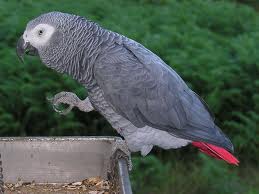
ALEX the African Grey Parrot

Today’s Feathery Friday animal is the African Grey Parrot and the most famous one ever was a bird named Alex. He was very adept at language and counting and picking out shapes and colors. Dr Irene Pepperberg worked very hard with Alex and learn all kinds of cool stuff about how birds think and behave! We’ve found some great videos that will give you a better idea of just how special Alex was! Check them out!

http://www.pbs.org/newshour/rundown/2011/05/a-new-take-on-bird-brains.html?utm_source=feedburner&utm_medium=feed&utm_campaign=Feed%3A+pbs%2Fnewshour-headlines+%28newshour-headlines%29


Categories: Animals, birds, Children, education, Environment | Tags: , , , , | Leave a comment

FEATHERY FRIDAY #5

FEATHERY FRIDAY#5

We’re very excited about today’s Feathery Friday! This bird is known to be very smart and great at imitating human speech. Wonder if they can do a good elephant or horse impression? Let’s meet today’s fabulous feathery friend…

MEET THE AFRICAN GREY PARROT!

Range/Habitat: West-Central Africa/lowland rainforest and farmland

Diet: Herbivore: fruit, nuts, leaves

Length/Weight: 13”/14 oz

Conservation Status: Common- Near Threatened

Fun Facts:

  • African Grey Parrots are highly social birds that live in flocks.
  • There are two subspecies (types) of African grey parrots: the Congo, who is larger and has a bright red tail and the Timneh, who is smaller and darker and has a maroon tail.
  • When flying in large flocks African greys call to each other and communicate by flashing their bright red tails.
  • They have a long life span. They can live up to 60+ years.
  • They are highly intelligent and have been compared to human toddlers.
  • African greys are highly vocal and are amazing at mimicking sounds and language!
  • Alex is an African Grey Parrot that worked with Dr Irene Pepperberg and was known to do things such as sort colors, shapes and count! We’re going to write a separate post about Alex- he was a very special bird!

African grey parrots are very special birds! They’re very smart and social, a great combination! If you could teach a parrot to say one thing, what would it be? Ellie would teach him to trumpet like her!


Categories: Animals, birds, Children, education, Environment | Tags: , , , , | Leave a comment

Animals go Back to School…

We’ve got another post today for Super Surprise Thursday! It’s all about how animals learn in zoos and aquariums in honor of all the kids going back to school!

Well, it’s that time of year again- BACK TO SCHOOL; time for kids pack up their backpacks and lunch boxes and head into a classroom. It’s time to pull out the pens, pencils and crayons and learn all kinds of fascinating information. We hope kids learn all about animals and nature during the year!

We know that kids get very excited about the beginning of the school year, but what about animals? Do you think they learn? Would it be unusual to see an orangutan sitting at a desk or a crow with glasses on, solving math problems? Well, maybe not! Animals learn too! Has anyone ever taught their dog to sit or shake hands? If you have taught your dog some of those tricks, then they learned something. Cool!

We thought it would be fun to look at some ways that animals learn in honor of this awesome time of year! Zoos and aquariums often use training to teach animals! The training is a great way to give the animals enrichment and it also helps keepers take care of the animals. What’s enrichment? Well, enrichment is a way to teach and entertain animals. Here’s an example, gorillas in Africa spend much of their day foraging or searching for food, but they don’t have to do that in a zoo.  Zoo keepers will put food in objects or scatter it around the enclosure so the gorillas have to search for it. It keeps the gorillas busy and it’s more like what gorillas would do in the wild.  Here’s a great explanation from Zoo Atlanta on enrichment:  http://www.zooatlanta.org/home/enrichment

Training also helps keepers take care of wild animals. You can’t just walk up to a tiger and give them a pill or walk up to a rhino ask them to get on a scale! Keepers work to train animals using positive reinforcement! They can train animals to show their mouths, sit on scales, and even to be given shots.  We’ve found some great websites on training animals in zoos and aquariums! Let’s check them out!

The St Louis Zoo does a great job taking care of their animals through training! http://www.stlzoo.org/animals/enrichmenttraining/animaltraining.htm Who knew it takes 3 people to give a giraffe a manicure? And who knew they needed manicures?

Disney also has a great site all about enrichment and training! Tons of great info! http://www.animalenrichment.org/guests.html

The National Zoo has a list of the items they use for enrichment: http://nationalzoo.si.edu/Animals/Primates/Enrichment/default.cfm

Here’s a great video about training:

http://www.youtube.com/watch?v=F7FE-UA2Z38&playnext=1&list=PLEF90075590A06F31


Animals have almost as much to learn as you do! Whew!  Did you know that there are chimpanzees that know sign language, that there are birds that can count and that there are animals that use tools? We’ll be writing about these amazing animals soon! Now it’s time to get back to your homework!

Categories: Animals, Atlanta, birds, Children, education, Environment, Local, mammals | Tags: , , , , | Leave a comment

SUPER SURPRISE THURSDAY #5

SUPER SURPRISE THURSDAY#5

We’ve made it to another Thursday and that means we have a Super Surprise animal today! Who will it be? Is it a lion or a bear or this guy…

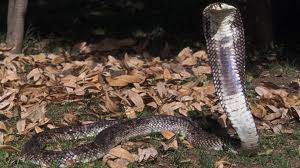
MEET THE EGYPTIAN COBRA!

Range/Habitat: Northwest Africa and East Africa/ desert and grasslands

Diet:  Carnivore: small mammals, snakes, birds and eggs

Length: 3 ½-8ft

Conservation Status: Common

Fun Facts:

  • The Egyptian Cobra is highly venomous snake.
  • They are nocturnal (active at night).
  • They are known to be aggressive and are quick to defend themselves.
  • They will “stand up” and spread open their hoods to make themselves look bigger.
  • Egyptian cobras are highly territorial and will often fight each other for territory.
  • Their venom is fatal to humans if not treated.

Egyptian cobras are quite intimating but are awesome! Remember that every animal has a place on this earth and even the ones that seem scary belong in their habitat! Just think, if we didn’t have snakes, we’d have tons and tons of rats and mice! They’re all part of the food web!

Recently an Egyptian Cobra made the news when she escaped from enclosure at the Bronx Zoo. Luckily she was found curled up in a corner of the reptile house!

http://cityroom.blogs.nytimes.com/2011/03/31/bronx-zoo-cobra-found-alive/

Categories: Animals, Atlanta, Children, education, Environment | Tags: , , , , | Leave a comment

WATERY WEDNESDAY #5

WATERY WEDNESDAY#5

Woohoo it’s another Watery Wednesday! We’ve found another fish that gets its name from a mammal. (Remember the Wolffish?) This one won’t roll over, sit or shake paws for you though. Can you guess what shark it is? Let’s meet…

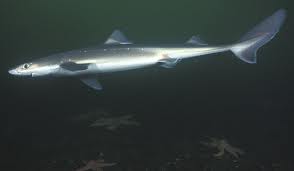
MEET THE SPINY DOGFISH!

Range/Habitat: Coastal waters-worldwide (generally under 59 degrees)

Diet: Carnivore: crustaceans, anemones, fish

Length: 3 ¼ ft- 5 ft

Conservation Status: Vulnerable

Fun Facts:

  • The Spiny dogfish is a small, slow moving, bottom dwelling shark.
  • They have venomous spines on both dorsal (top) fins that are used for defense and can cause painful wounds.
  • They are often found swimming in large schools. They often feed together in large groups or “packs”. This feeding behavior is most likely where the name dogsfish came from. (Wild dogs also feed in packs or groups.)
  • They are known to be aggressive and voracious eaters.
  • They have one of the longest known gestation periods (time of pregnancy) of any shark (or any vertebrate for that matter) around 24 months (2+ years). That is longer than an elephant!

The Spiny dogfish is a cool and strange looking little shark, but with those venomous spines we’re glad this shark doesn’t shake fins ;)!

Categories: Animals, Children, education, Environment | Tags: , , , , , | Leave a comment

REPTILIAN TUESDAY #5

REPTILIAN TUESDAY#5

Happy Tuesday! We hope everyone enjoyed Labor Day! We’re back with a funny looking reptile that has horns! What? Yep, we said horns! Some say it even looks like a dinosaur, but it’s not! Who is this awesome lizard? Let’s find out…

MEET THE JACKSON’S CHAMELEON!

Range/Habitat: East Africa-Kenya/Tanzania/ High altitude mountainous regions

Diet:  Carnivore: insects

Length: 8-12”

Conservation Status: Common

Fun Facts:

  • Male Jackson’s Chameleons have 3 bony horns on the front of their head.
  • They use the horns to fight other males for territory.
  • Female Jackson’s Chameleons do not have horns.
  • Like other chameleons, they can change their color depending on their mood, health and surroundings.
  • They are bright green. Their ability to camouflage with their habitat is their primary defense mechanism.
  • Jackson’s chameleons do not lay eggs; females incubate the eggs inside her body and give birth to live young.
  •  Baby chameleons are brown and turn green around the age of 4 months.

These crazy chameleon look kind of like triceratops or a rhino to us! We think they are fantastic! What do you think?

Categories: Animals, Children, education, Environment | Tags: , , , , , | Leave a comment

FEATHERY FRIDAY #4

FEATHERY FRIDAY#4

It’s FRIDAY and we have another great Feathery friend for you to meet today! As summer wraps up here, we’re dreaming of cooler temperatures and today’s bird loves the cold! Is it a penguin? Nope this bird lives in the Northern Hemisphere…

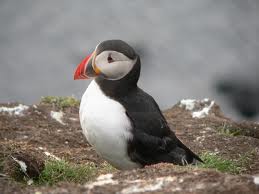
MEET THE ATLANTIC PUFFIN!

Range/Habitat: North Atlantic and Arctic Oceans from Northern Europe-Iceleand-Newfoundland / ocean and rocky coasts

Diet:  Carnivore: fish, mollusks, crustaceans

Length/Weight: 11-12”/ 1 lb

Conservation Status: Common

Fun Facts:

  • The Atlantic Puffin is a highly social bird that lives in large colonies on rocky coasts and islands.
  • They have bright orange beaks that are brighter during mating season. They also have bright orange feet. They’ve been called the “sea parrot” because of their bright coloration.
  • Male and female Atlantic Puffins incubate eggs.
  • Atlantic Puffins spend their winters out in the open ocean.
  • They are excellent swimmers and divers. They can dive up to 200 ft deep.
  • Atlantic Puffins can fly unlike penguins.
  • They can catch several fish at one time.
  • Atlantic Puffins are the Provincial (official) bird of Newfoundland, Canada.


Atlantic Puffins sure are snappy looking birds with their bright orange beaks and feet! And they can fly and swim! We wish we could fly and swim!


Categories: Animals, birds, Children, education, Environment | Tags: , , , , | Leave a comment

Blog at WordPress.com.