Posts Tagged With: mammals

MAMMAL MONDAY # 28

MAMMAL MONDAY # 28

Happy Mammal Monday! We’re extra excited for you to meet today’s primate! We’re heading to the rainforests of Central Africa! These monkeys have brightly colored faces! Grab your bug spray and your rain gear and let’s head into the forest to see these majestic animals!

MEET THE MANDRILL!

   Range/Habitat: Western Central Africa/ rainforests

   Diet: Omnivore: fruit, seeds, invertebrates

   Length/Weight: 25-32”/24- 82 lbs

  Conservation Status: vulnerable


Fun Facts:

  • Mandrills are the largest of all monkeys.
  • They have brightly colored faces with red and blue.
  • Mandrills also have brightly colored rumps with short tails.
  • Mandrills have large 2 ½ inch canine teeth. They will bear them to other mandrills; it is most often a friendly gesture.
  • They are related to baboons, but are not baboons.
  • Mandrills store food in their cheeks while they’re foraging.
  • They spend most of their lives on the ground, but sleep in the trees.
  • Female mandrills are much smaller than the males.
  • They live in troupes. The troupes are led by a dominant male and include females, young and non-ranking males.  Troupes will also join other groups and form large hordes.

We just love the colorful Mandrill. They have a very interesting social structure and are very intelligent. Unfortunately their rainforest home is disappearing. Doing things like recycling paper can really help protect our rainforest homes! Who’s up for recycling as much paper as they can? We are!

Categories: Animals, Children, education, Environment, mammals, nature, science, wildlife | Tags: , , , , , , , | Leave a comment

March Craft/Activity!

Hey everyone! So this month’s craft is really more of an activity to get you outside! We’re a bit late with posting it, because we had some IT issues with our conversion :)! Anyways, we hope you enjoy BACKYARD BINGO! That’s right folks, we made you a bingo game to take outside to your backyard or your local park!  It’s PDF (our first) so please let us know if you have any trouble printing it!


Get outside and Enjoy!!!

Backyard bingo-1

Categories: Animals, backyard, birds, Children, crafts, education, Environment, insects, Local, mammals, nature, reptiles, science, wildlife | Tags: , , , , , , , , | 6 Comments

MAMMAL MONDAY # 27

MAMMAL MONDAY # 27

We’re back to our regularly scheduled program this morning and it’s time to meet a flying mammal from the deserts of Northern Africa! That’s right folks, we’re talking bats today and have we found a tough little one for you today! Grab your night vision goggles and let’s head out to the desert on the Mammal Monday!

MEET THE DESERT LONG EARED BAT!

   Range/Habitat: North Africa-Western Asia/deserts

   Diet: Carnivore: insects, scorpions

   Length/Weight: 2 ½-2 ¾”/ 1 oz

   Conservation Status: least concern


Fun Facts:

  • Desert Long Eared Bats are one of the few desert dwelling bat species on earth.
  • Desert long eared bats roost in groups in caves and buildings.
  • Their ears are around 1 ½” long and sit horizontally on their foreheads.
  • They are known to go into a hibernation like state during very dry periods or droughts.
  • Desert long eared bats often hunt in pairs.
  • Their main prey item are scorpions! They even eat very toxic scorpions, including their poison glands.
  • When Desert long eared bats attack a scorpion they often get stung on the face without harm, because they are immune to the venom.


WOW! Can you imagine eating a scorpion? We would definitely like to avoid having them on our menus, but these awesome bats don’t only eat them but they are immune to their venom! Animal’s adaptations just never cease to amaze us!


Categories: Animals, bats, Children, education, Environment, mammals, nature, science, wildlife | Tags: , , , , , , , , | 6 Comments

BACKYARD ANIMAL WEEK!

BACKYARD ANIMAL WEEK!

(MAMMAL MONDAY)


It’s March Theme Week! Who’s excited? We sure are, because we are focusing on animals in your backyard! Do you ever just go out in your own backyard or to a local park and notice that there is actually quite a bit of wildlife? There are all kinds of fabulous creatures to see big and small. We often think of animals as being something you see on TV in Africa or South America, but nature is usually right outside our front door! So let’s spend the week exploring the natural world right outside in our own backyards! We’ll be focusing on animals in our backyard this week, but we would love for you to share animals in your backyard too! First up a marsupial that lives in North America!

MEET THE VIRGINIA OPOSSUM!

   Range/Habitat: North America-Central America/ woodlands, urban,

grasslands

   Diet: Omnivore: grub, eggs, fruit, carrion

   Length/Weight: 13-20”/ 4 ½-12 lbs

   Conservation Status: common

Fun Facts:

  • Virginia Opossums are the only marsupial in North America. (Marsupials are mammals that give birth to very small young. The young then develop and grow in their mother’s pouch.)
  • They are nocturnal (active at night).
  • Virginia Opossums have hairless, prehensile tails. They can hang from their tails, but for only short periods of time.
  • Virginia Opossums have opposable thumbs on their back paws.
  • They have 50 teeth, the most of any North American mammal!
  • Virginia Opossums can carry up to 13 babies in their pouches. They young leave the pouch after 70 days.
  • Their most famous trait is their ability to “play dead” when they are threatened. They lay in a coma like state and can stay that way for up to 6 hours.

Opossums get a bad rap and we admit they aren’t the cutest thing in our back yards, but they are an essential part of the urban ecosystem! Plus, they are our only marsupial and we think that’s pretty cool!

Categories: Animals, Children, education, Environment, mammals, marsupial, nature, reptiles, science, wildlife | Tags: , , , , , , , | 1 Comment

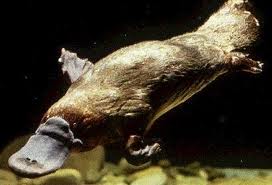
HAPPY PLATYPUS DAY!

HAPPY PLATYPUS DAY!

Happy Mammal Monday! We have traveled to the land down under-Australia to find today’s animal! Australia is a large continent with wild and strange animals that are found no other place on earth and today’s mammal is no exception! In fact this mammal is a rare exception to the rule, instead of giving birth to live young it lays eggs! WHAAAAT? You heard right, this mammal lays eggs! Let’s meet… (This was Mammal Monday #15)

MEET THE PLATYPUS!

   Range/Habitat: Eastern Australia-Tasmania/rivers-streams-rainforest

   Diet: Carnivore: worms, shrimp, crayfish

   Length/Weight: 16-23 ½”/ 1 ¾-5 ½ lbs

   Conservation Status: common


Fun Facts:

  • Platypus are strange looking mammals, with long slender bodies, webbed feet and a duck-like bill for a mouth.
  • They have long tails that look like beaver tails.
  • Platypus are built for water. They are excellent swimmers and can dive to deep depths looking for prey.
  • They eat about 20% of their body weight a day (about 2lbs), so they can spend up to 12 hours a day feeding.
  • Platypus have no teeth!
  • Male platypus have venomous spurs in the back feet. The venom is not fatal to humans, but can be very painful.
  • Platypus can detect the electrical fields of other animals. They use this extra sense to find their prey!
  • They are one of two mammals on earth that lay eggs. Do you know the other one?
  • Platypus moms to provide milk to their offspring.

Platypus are one of our favorites, with their crazy looking bill mouths and their webbed feet! They are much loved in Australia too! You can find a platypus on the back of their 20 cent coins! Neat! Edmond wants to be on a coin! Ellie told him he’d have to learn to lay eggs first!

Categories: Animals, Children, education, Environment, mammals, nature, science, wildlife | Tags: , , , , , , , | 2 Comments

SUPER SURPRISE THURSDAY # 26

SUPER SURPRISE

THURSDAY# 26

Woohoo! It’s time for another Super Surprise Thursday and we found a member of the pig family for you! You better be ready to head to the African, because this pig likes the warm grasses of the savanna! Who’s ready?

MEET THE WARTHOG!

    Range/Habitat: Africa/ grasslands

   Diet: Herbivore: grasses, seeds

   Length/Weight: 3-5 ft/ 110-330 lbs

   Conservation Status: Common


Fun Facts:

  • Warthogs have four “warts” on their faces.
  • They also have two pairs of tusks (lower and upper) that point upward.
  • Warthogs have a mane of hair down their neck and back.
  • Warthogs live in mixed groups called sounders.
  • They are the only member of the pig family that is made for grazing.
  • They kneel on padded front “wrists/elbows” when they bend down to eat grass.
  • They are diurnal (active during the day).
  • Warthogs live in burrows.


What’s not to love about warthogs? Look at those cute faces and those neat manes of hair and those warts! Ok, maybe they’re not the cutest animal on the planet, but they are special none the less!

Categories: Animals, Children, education, Environment, mammals, nature, science, wildlife | Tags: , , , , , , , | 2 Comments

HAPPY INTERNATIONAL POLAR BEAR DAY!

HAPPY INTERNATIONAL POLAR BEAR DAY!

Do you have your coat on for this Mammal Monday? Well, if you don’t you better grab it because all this week we are heading to the chilly arctic circle! In honor of the holiday and the fat guy who lives at the North Pole, we’ve decide to spotlight animals who live there too! First up, a large and in charge bear! Are you all bundled up? Let’s go! (This post was originally posted on Dec 19th as Mammal Monday #19)

MEET THE POLAR BEAR!


   Range/Habitat: Arctic/ice, shoreline

    Diet: Carnivore: seals, carrion

   Length/Weight: 7-11ft/800- 1500lb

   Conservation Status: Vulnerable (In Canada)


Fun Facts:

  • Polar bears are the largest members of the bear family and the largest land carnivore on earth.
  • They have two coats of fur, an outer translucent coat that absorbs the sun’s heat and a dense undercoat.
  • Polar bears have black skin that helps them absorb heat.
  • They also have a thick layer of blubber to help them stay warm.
  • Polar bears have rough pads on their paws that help prevent them from slipping and sliding on the ice.
  • They are excellent swimmers and are often seen in open waters.
  • They use their large front paws to swim.
  • Polar bears can smell a seal from a half mile away.
  • Female polar bears dig dens in winter and stay there to give birth to 1 to 3 cubs.
  • Polar bear cubs stay with their moms until around the age of 2. They spend that time learning to hunt and be polar bears!

Polar bears are amazing animals! They are built to live in the cold arctic! These large and in-charge bears are a protected species! We hope to have them around for a very long time!


Categories: Animals, Children, education, Environment, mammals, nature, science, wildlife | Tags: , , , , , , , | 3 Comments

MAMMAL MONDAY # 25

MAMMAL MONDAY# 25

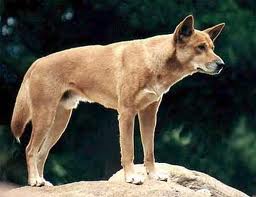
Happy Mammal Monday! We’re back to our regular scheduled mammals! We sure hope you enjoyed our Valentine’s week! We’re heading to the land down under today to meet today’s animal! These members of the dog family are pretty cool! Are you ready to meet them? Let’s do this!

MEET THE DINGO!

    Range/Habitat: Australia/ wetlands-grasslands-forests

    Diet: Carnivore: rodents, rabbits, birds

    Length/Weight: 28-43”/ 20-47 lbs

    Conservation Status: Vulnerable


Fun Facts:

  • Dingoes are likely descendants of domestic dogs.
  • It is thought that came to Australia around 4,000 years ago.
  • Dingoes are often found alone, but will hunt in pairs and small family groups or packs.
  • Dingoes are mostly nocturnal (active at night).
  • They do not bark, but howl.
  • They have long bushy tails.
  • Dingoes often breed with domestic dogs, so pure dingoes are vanishing.


Dingoes are really cool members of the dog family. They are often considered pests in Australia and many ranchers build dingo fences. These predators are very important to their ecosystem though, because they keep prey populations in check!

Categories: Animals, Children, education, Environment, mammals, nature, science, wildlife | Tags: , , , , , , , | Leave a comment

VALENTINE’S MONDAY

VALENTINE’S MONDAY

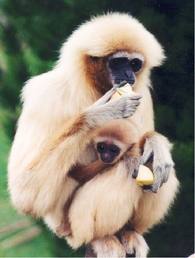
It’s February theme week and we’re celebrating Valentine’s! We’ll be featuring animals who mate for life all week! So get ready to show some love for some fabulous pairs of animals! We have a lovely primate for Valentine’s Mammal Monday! These apes live in the rainforest of Asia and are known for their songs! Everyone look up, they’re swinging in the trees!

MEET THE WHITE HANDED GIBBON!

    Range/Habitat: Southeast Asia/ mountains-forests-rainforest

    Diet: Omnivore: fruit, leaves, insects

    Length/Weight: 16-23”/ 10-17 lbs

    Conservation Status: Endangered


Fun Facts:

  • White Handed Gibbons are apes. They do not have tails!
  • White handed gibbons are arboreal (live in trees).
  • They truly swing through the trees. This is called brachiation.
  • White handed gibbons have opposable thumbs and toes to help them grip vines and branches!
  • They often pair/mate for life.
  • Each pair of white handed gibbons has an individual song/call that they use to locate each other in the rainforests.
  • White handed gibbons coloration varies from black to brown to tan.
  • White handed gibbons life span is 25-30 years.


White handed gibbons are fabulous! We love their songs and the way they swing through the trees! Wouldn’t it be fun to swing like that? If you were a gibbon what would be the song you shared with your sweetie? We’re still deciding!

Check out this video of a gibbon calling and swinging through his enclosure!

http://www.youtube.com/watch?v=Gzgr2KBaEgY

Categories: Animals, Children, education, Environment, mammals, nature, science, Valentines, wildlife | Tags: , , , , , , , , | Leave a comment

SUPER SURPRISE THURSDAY # 24

SUPER SURPRISE THURSDAY# 24

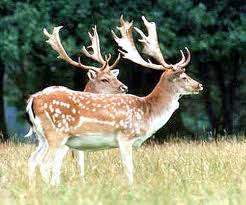
Who’s that mammal with the big antlers? It’s our Super Surprise animal! We’re heading back to Europe to meet a woodland dweller! Are you ready to head into the woods? We are!

MEET THE FALLOW DEER!

   Range/Habitat: Europe-Asia/ woodland, grassland

   Diet: Herbivore: grasses, acorns

   Length/Weight: 4 ½-6 ¼ ft/ 77-300lbs

   Conservation Status: Common


Fun Facts:

  • Fallow Deer live in large herds of up to 100 individuals.
  • Their coloration varies by where they live.
  • Fallow deer are most active at twilight.
  • Male fallow deer have large broad antlers.
  • They can run up 25 mph.
  • Fallow deer fawn hide in vegetation to protect themselves from predators.  This behavior is called lying-up.


Wow! Aren’t these deer magnificent with their broad antlers? We love them! And how about lying-up? We hadn’t heard that term before! We thought lying-up meant laying around doing nothing- like the cat we live with does all the time!


Categories: Animals, Children, education, Environment, mammals, nature, science, wildlife | Tags: , , , , , , , | Leave a comment

Blog at WordPress.com.