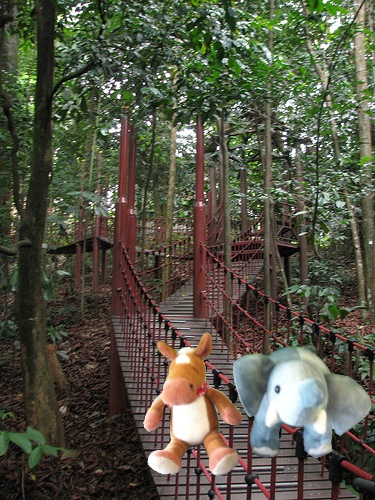
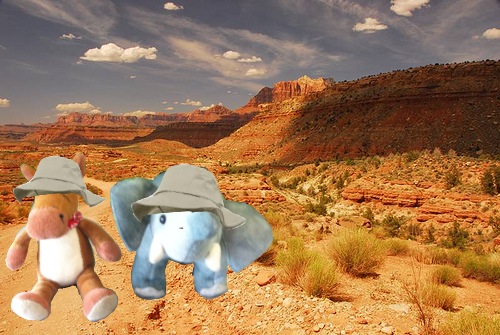
adventure

ANIMAL INTELLIGENCE WEEK!

ANIMAL INTELLIGENCE WEEK!

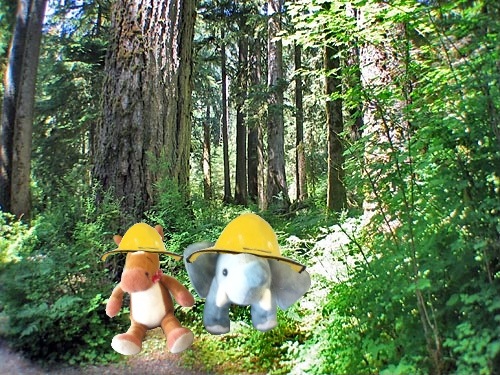
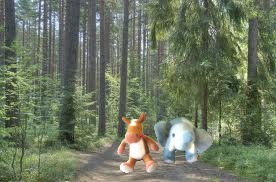
As children all over are heading back to school to learn and grow, we here at Ellie and Edmond headquarters want to celebrate amazingly intelligent animal friends! And you humans thought you were smart! Scientists all over the world are realizing that animals can learn language, use tools and even recognize themselves in a mirror. We’re off to the rainforests of West Africa to meet our first smarty and human kinds’ closet living relative! Let’s head out on this adventure!

MEET THE COMMON CHIMPANZEE!

   Range/Habitat: West-Central Africa/ rainforest

   Diet: Omnivore: invertebrates, fruits, nuts

   Length/Weight: 25-35”/ 60-130 lbs

   Conservation Status: critically endangered


Fun Facts:

  • Chimpanzees are highly social and live in complex social groups.
  • They can make 30 plus different kinds of calls and vocalizations.
  • Chimpanzees have a wide variety of facial expressions.
  • Chimpanzees are tool users and tool makers. They make tools from sticks and extract termites or ants with the stick. They also use things like rocks to crack open nuts.
  • They build nests to sleep in at night. They build a new one every night.
  • Chimpanzees learn tool making/using behavior from their mothers and other chimps.
  • They use cooperative and complex hunting skills to capture live prey.
  • Chimpanzees have been known to learn sign language.
  • They can recognize themselves in a mirror.

We could go on and on about these amazing apes! We still have so much to learn from them. There is even a Bonobo chimp who has learned complex language named Kanzi, read more about him here. Sadly, these apes are very endangered and it critically important that we all work to ensure their future. Jane Goodall, one of our personal heroes, has been studying and working with chimpanzees for many years. The Jane Goodall Institute is great place to learn more about how to help the apes! Also check out the movie Chimpanzee, you will love it!


Categories: adventure, Animals, apes, Children, conservation, education, Environment, mammals, nature, rainforests, science, wildlife | Tags: , , , , , , , , , | 1 Comment

WINNERS ANNOUNCED!!!

WINNERS ANNOUNCED!!

We haD such a blast with our first ever Conservation Photo Contest! You guys sent in some great photos and we truly thought each photo was awesome! We had an independent panel of judges pick their top 3 favorites and we had 4 honorable mentions!
Our top picks will receive an Ellie and Edmond reusable mug and our honorable mentions will get a nifty certificate and a magnet :)!

We will notify the winners and will need mailing info from them!

DRUM ROLL PLEASE……..

OUR FIRST ANNUAL CONSERVATION PHOTO CONTESTS WINNERS ARE (in no particular order):

Mr Bear recycles!

SiberianForrest uses dog power!

Aska Rabbit meets a zebra shark!

HONORABLE MENTIONS! Our judges couldn’t decide :)!

DigSowGrow paints garden boxes!

Rocky unplugs appliances when not in use!

Happiii grows blueberries!

Tour Guide Ted at the Hoover Dam!


THANK YOU SOOOOO MUCH FOR ENTERING OUR PHOTO CONTEST EVERYONE! OUR JUDGES HAD A VERY HARD TIME PICKING THEIR FAVORITES! MAYBE NEXT YEAR OUR BUDGET WILL BE BIGGER & EVERYONE CAN GET A PRIZE! HAVE A GREAT DAY!

ELLIE & EDMOND

Categories: adventure, Animals, Children, conservation, contest, education, Environment, nature, photography, wildlife | Tags: , , , , , , , | Leave a comment

FEATHERY FRIDAY GREATEST HITS!!

FEATHERY FRIDAY GREATEST HITS!!

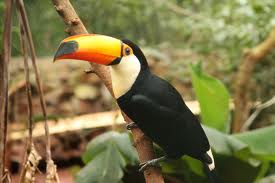
On this Feathery Friday we went in search of a beautiful beaked bird! Whew! We’ve made it to another Friday and we’re so happy that it’s full of feathers! Our bird friends come in so many shape and sizes and today’s bird has a giant beak! Who is this amazing bird with the big ole beak?

MEET THE TOCO TOUCAN

   Range/Habitat: North Eastern-Central South America (Bolivia-

Peru-Argentina)/woodland, forest, groves

   Diet: Omnivore: insects, fruits, frogs

   Length/Weight: 21-23”/20 oz

   Conservation Status: Common


Fun Facts:

  • Toco Toucans are the largest of all toucans.
  • They have large orange bills with a black spot. The bills can get up to 7 ½” long (about the length of a pencil).
  • Toco Toucan bills are serrated (like a knife) and this helps them grasp and tear fruit.
  • Their large bills also enable the toucan to get fruit from out of reach branches.
  • Toco toucans nest in trees.
  • You can see Toco toucans in small flocks of up to 6 birds.
  • Both female and male toucans incubate the eggs.

Toco Toucans are really pretty birds with their shiny black feathers and large orange beaks! And man does that beak come in handy when you’re trying to get the fruit on the end of the branch! They also have a really cool call. Take a listen and Happy Feathery Friday!


Categories: adventure, Animals, birds, Children, conservation, education, Environment, nature, rainforests, science, wildlife | Tags: , , , , , , , , | Leave a comment

SUPER SURPRISE THURSDAY GREATEST HITS!

SUPER SURPRISE THURSDAY GREATEST HITS!!

We went Africa to meet one unique mammal on this Greatest Hits! Who’s excited? We are! This mammal has some very special adaptations to help them eat the leaves that others can’t! So let’s meet…

MEET THE GERENUK!

   Range/Habitat: East Africa/dry and bushy scrub

   Diet: Herbivore: leaves

   Length/Weight: 4 ½ -5 ¼ ft/62-115 lb

   Conservation Status: Near Threatened


Fun Facts:

  • Gerenuks are part of the antelope family.
  • They have long slender bodies, necks and small faces.
  • Gerenuks can curve their spines into an S shape, which enables them to stand on their hind legs.
  • Because they can stand on their hind legs, they can eat leaves that other animals can’t reach.
  • Gerenuks are also called the giraffe gazelle.
  • They have large ears and eyes that help them hear and see predators.
  • Only male gerenuks have horns.
  • They get all of their water supply from the leaves they eat, so they can survive in dry habitats.

Gerenuks are kind of funny looking with their long thin bodies and giant ears. We think it’s super cool that they can stand up on their hind legs to eat! What a neat adaptation!  They are called the giraffe gazelle, but they’re not related to the giraffe.

Categories: adventure, africa, Animals, Children, conservation, education, Environment, mammals, nature, science, wildlife | Tags: , , , , , , , , | 2 Comments

WATERY WEDNESDAY GREATEST HITS!

WATERY WEDNESDAY GREATEST HITS!!

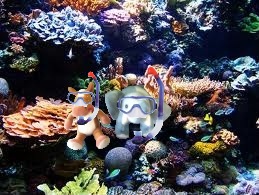
We went to a coral reef for this Watery Wednesday! Coral reefs are like the rainforests of the oceans! Reefs are full of all kinds of strange and wonderful animals and we have a strange looking fish for you today! This fish grows warts! Yep, warts! Eeew! Let’s meet the odd looking fish…

MEET THE WARTY FROGFISH!

   Range/Habitat: Western Pacific-Indian Oceans/coral reefs

   Diet: Carnivore: small fish, crustaceans

   Length/Weight: up to 4 ½”

   Conservation Status: Common


Fun Facts:

  • Warty Frogfish are relatives of anglerfish.
  • Instead of dorsal fins, they have long spines which act as lure to catch prey. If the top of the lure breaks off, they will regenerate a new one.
  • Warty frogfish are ambush predators, meaning they lay in wait for prey to swim by and then they grab them!
  • Young warty frogfish are white with yellow, orange or red. They develop their warty bumps as adults.
  • Warty frogfish are experts at mimicry and camouflage. They don’t just blend in with their surroundings, they actually look coral!

Wow, warty frogfish are some crazy looking fish and excellent at blending in with their habitats!  If you didn’t see them moving you might just miss them! Plus warty frogfish is just fun to say! Try and say it fast three times! Warty frogfish, warty frogfish, warty frogfish! Poof- now you are one :)!

Check out this video of a warty frogfish ambushing its prey!


Categories: adventure, Animals, Children, conservation, education, Environment, fish, nature, oceans, science, wildlife | Tags: , , , , , , , , | 1 Comment

REPTILIAN TUESDAY GREATEST HITS!

REPTILIAN TUESDAY GREATEST HITS!

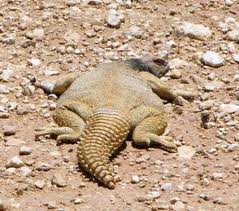
We went to North Africa to meet a great lizard on this past Reptilian Tuesday! We’re off to the desert to meet one cool lizard! Grab your sunscreen and hat and let’s head out!

MEET THE SPINY DAB LIZARD!

   Range/Habitat: N Africa/deserts

   Diet: Omnivore: insects/plants

   Length: 12-16”

   Conservation Status: Common


Fun Facts:

  • Spiny Dab Lizards is also known as the Spiny tailed lizard or Uromastyx.
  • Their tales are covered with spiny scales.
  • Spiny Dab lizards are often found in burrows in the desert. They will stick their tails out of the entrance of the burrow to protect it.
  • Males are very territorial.
  • They hibernate during the winter months.
  • Spiny dab lizards change their color according to the temperature of the environment. They are yellowish/gray during the winter and orange/green or red during the warmer months!
  • Spiny dab lizards come out during the day to warm themselves in the sun. They are more active during warmer periods.

Animals have some great adaptations! These awesome lizards not only have spiny tails but they can change their color! We wish we could change colors! What color would you want to be? Ellie wants to be purple :)!


Categories: adventure, africa, Animals, Children, conservation, education, Environment, lizards, nature, reptiles, science, wildlife | Tags: , , , , , , , , , | Leave a comment

MAMMAL MONDAY GREATEST HITS!

We’re doing one more week of Ellie and Edmond’s Greatest Hits as we finish up some projects at headquarters! We hope you enjoy these fun animals!

MAMMAL MONDAY GREATEST HITS!!

On this Mammal Monday we went to the rainforests of South America to find our first primate! We have a very special friend today. It’s our first primate! These adorable little monkeys sport a wild hairdo! Let’s get ready to meet…

MEET THE COTTON TOP TAMARIN!

   Range/Habitat: Northwest South America/rainforest, forest

   Diet: Omnivore: fruit, plants, insects

   Length/Weight: 8-10”/14-16 oz

   Conservation Status: endangered


Fun Facts:

  • Cotton Top Tamarins are small New World monkeys. New World monkeys live in Central and South America.
  • They live in family troops of 10-12 monkeys that are made up of a mated pair and their offspring.
  • Cotton top tamarins often give birth to twins.
  • Like other tamarins, cotton top dads and older siblings help raise the babies. They carry the babies on their backs.
  • Cotton top tamarins are arboreal (they live in the trees).
  • Their tails are very long, 13-16”.  That’s longer than its body! The tail helps them balance while they get around in the trees.
  • Cotton top tamarins are very vocal and have lots of different calls, to express danger, fear, joy and playfulness.
  • They use calls to warn each other of predators. There are different warning calls for predators in the air and predators on the ground.

These little monkeys are about the size of a squirrel, but have much better hairdos :)! How great is it that they dad and siblings help with the babies?


Categories: adventure, Animals, Children, conservation, education, Environment, mammals, rainforests, science, wildlife | Tags: , , , , , , , , , | 1 Comment

FEATHERY FRIDAY GREATEST HITS!

FEATHERY FRIDAY GREATEST HITS!

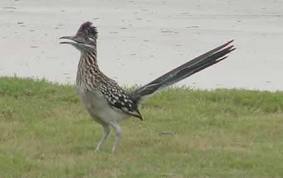
We went to the desert on this day to meet a famous bird! Have you ever seen the cartoon where there’s a coyote and a roadrunner? Did you know that there are real roadrunners? Well they are real and they’re pretty cool! So let’s meet our feathery friend the…

MEET THE GREATER ROADRUNNER!

   Range/Habitat: Southwestern United States-Northern Mexico/desert and scrub

   Diet: Carnivore: lizards, snakes, scorpions and spiders

   Length/Weight: 22”/12 oz

   Conservation Status: Common


Fun Facts:

  • Greater Roadrunners can fly but spends most of its time on the ground.
  • They can reach speeds of up to 18 mph! That is one fast bird.
  • Greater roadrunners generally walk/run to catch their prey.
  • They use their large beaks to attack prey.
  • They have long tails that they lay flat when running.
  • Greater roadrunners have black skin under their feathers. They expose the skin to the sun to absorb heat.

We all love watching the coyote roadrunner cartoons, but the real roadrunner is more fun! They are fast and furious little birds. How fast can you run? You should try and be a roadrunner for the day!


Categories: adventure, Animals, birds, Children, conservation, education, Environment, nature, science, wildlife | Tags: , , , , , , , , | Leave a comment

SUPER SURPRISE THURSDAY GREATEST HITS!

SUPER SURPRISE THURSDAY GREATEST HITS!

We went to Australia to meet this feathery animal! Who is it, you say? Well it’s a bird you think would say who but this one doesn’t! Whooooo is it then?

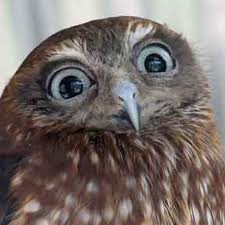
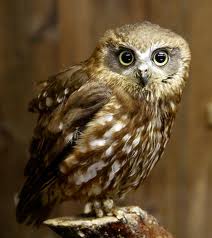
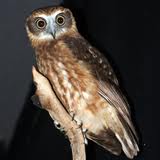
MEET THE BOOBOOK OWL!

   Range/Habitat: Australia-South New Guinea/forests, grasslands, farmlands

   Diet: Carnivore: insects, birds, mammals

   Length/Weight: 12-14”/6-10oz

   Conservation Status: Common


Fun Facts:

  • Boobook owls are named after the call it makes.
  • They are nocturnal like other owls, but often feed at dusk and dawn too!
  • Boobook owls are specialists at catching prey in mid-air.
  • They have grey beaks and feet.
  • Both females and males take care of the chicks.

This funny little owl doesn’t make the typical who call! That’s what makes it so special! Listen to it here.


Categories: adventure, Animals, birds, Children, conservation, education, Environment, nature, science, wildlife | Tags: , , , , , , , , | 1 Comment

WATERY WEDNESDAY GREATEST HITS!

WATERY WEDNESDAY GREATEST HITS!

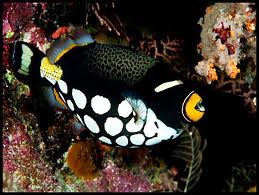
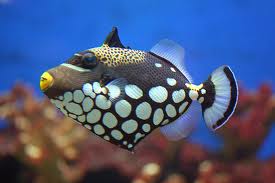
On this Water Wednesday we went to a coral reef to find a comical fish! Ok, this fish really isn’t that funny, but it is named after clowns and they’re usually funny, unless you’re scared of them! Let’s meet this fun fish…

MEET THE CLOWN TRIGGERFISH!

   Range/Habitat: Pacific-Indian Oceans/Coral reefs

   Diet: Carnivore: mollusks, crustaceans

   Length/Weight: up to 20”/up to 4 ½ lbs

   Conservation Status: Common


Fun Facts:

  • Clown triggerfish are very colorful.
  • They have strong and sharp teeth for crushing the shells of their prey.
  • Clown triggerfish can wedge in cracks and crevices of the reef when threatened by predators.
  • They usually do not use their tail fin to swim. They use their dorsal (top) and anal (bottom) fins to swim!
  • Clown triggerfish are very territorial.
  • Both male and female clown triggerfish protect the nest of eggs until they hatch.

These crazy looking Clown triggerfish sure are cool! If you could create your very own fish, what colors would you use?


Categories: adventure, Animals, Children, conservation, education, Environment, fish, nature, oceans, science, wildlife | Tags: , , , , , , , , , | Leave a comment

Blog at WordPress.com.