SUPER HORSE TO THE RESCUE-
SOUTH FLORIDA WILDLIFE CENTER

We found South Florida Wildlife Center on Facebook and saw what wonderful work they are doing in their area. Dr Renata Schneider, their director of Rehabilitation was kind enough to take some time and tell us about herself and the center! Come read Super Horse’s interview with this Wildlife Hero!

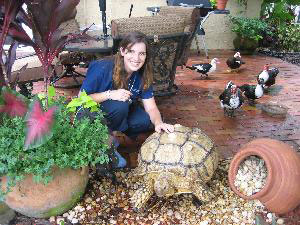
Dr Schneider
Super Horse: Tell us about your center.
Dr. Schneider: The South Florida Wildlife center is a 501C3 organization (not for profit.) We have over 60 staff members and over 600 volunteers. We are located in Fort Lauderdale, FL. While we are in Broward County, we serve the South Florida Tri-County area (Palm Beach, Broward and Dade). South Florida Wildlife Center is an affiliate of the Humane Society of The United States. We rescue, rehabilitate and release thousands of native animals yearly.

Feeding a Quaker Parrot
Super Horse: Wow that is a big area to serve! That must keep you very busy! Tell us about you and your job at the center. What is your favorite part of your job?
Dr. Schneider: My name is Renata Schneider. I am a Veterinarian and my position at the South Florida Wildlife Center is Director of Rehabilitation. In my position I spend 2-3 days a week in the clinic examining incoming patients, making treatment plans, performing surgeries and rechecking existing patients. The other 2-3 days a week are spent evaluating animals that are no longer on medication and have moved to an outdoor habitat. I check on their progress, make medical decisions regarding the care, and work to improve the rehabilitation process to ensure a successful release. This includes working on habitat designs, enrichment and improvements.
My favorite part of the job is when an animal that I treated is released; all of our hard work has paid off! However, I do love the daily hustle and bustle and the variety of animals that we see and the resources that we have access to in order to practice good medicine and excellent rehabilitation techniques.

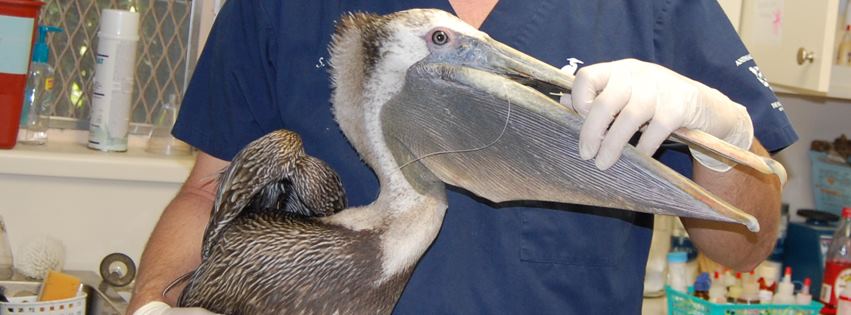
Pelican with ingested hook.
Super Horse: Your job sounds so amazing! How did you get into wildlife rehabilitation?
Dr. Schneider: When I was 17 years old I started volunteering at a “Le Nichoir”, a song bird rehabilitation center in Quebec, my home province. I assisted in the hand rearing of orphan birds for a summer. I had always loved animals, but did not ever think of becoming a veterinarian. When I learned that veterinarians could work with wildlife I changed career paths. I literally refused an offer to Law School and started over with my college classes to get the pre-requisites for veterinary school. My new goal was to become a wildlife Veterinarian; I graduated with the doctorate of veterinary medicine in 2002. It was many years later that I finally applied for my rehabilitation license!

Raccoon gets a bath!
Super Horse: We bet the animals are glad you skipped law school. What does a typical day look like at the center?
Dr. Schneider: The South Florida Wildlife Center is a very busy place. We admit up to 100 new patients daily. Each staff member is always very busy, but I will describe a typical day for me.
I arrive at or before 8am. First thing, I check on patients in the Intensive Care Unit, they are usually the most critical. Then I check on any animals that came in late the night before in case they did not get seen by a doctor. Finally I make sure that the nursery knows that there are orphan birds, squirrels, opossums or raccoons that are ready to be admitted into the nursery and get their breakfast.
Throughout the day I use my “doctor check list” to know which existing patients need a recheck. While a technician gets one of these patients, a hit by car Virginia Opossum ends up on the triage table. I will sedate the opossum and then recheck my patient while he is getting relaxed. Patient recheck done, examine the opossum. I can feel a fracture in the jaw. One veterinary technician will get radiographs for me, while another technician gets the Pelican that needs a bandage change for an open wound.
By 10am we have looked at over 10 animals. There are probably three more sets of radiographs that need to be done, a dove waiting for a laceration repair, and blood work that needs to be analyzed.
Throughout the day this pattern continues of triaging incoming patients, filling out all of the important paperwork associated with each case, and rechecking existing patients.
At 1pm I am told that one of our hawks is bleeding in its outdoor enclosure. The animal care staff member tending to this patient brings him inside. This red-tailed hawk has a broken a new feather, that still has blood in its shaft. We control the bleeding and send him back outside. He won’t need to stay inside on medications.
At 2pm I am told that there are no indoor cages left for pelicans. It is a full house! It is time to do rounds in the hospital to see if any patients are strong enough for an outdoor enclosure. We manage to move out 2 pelicans, now we have 2 hospital cages available for new patients.
At 3pm the ambulance comes back with its second load of the day. It is time to triage 20 new patients. We start with the most critical and the youngest. Luckily we made some more room in the hospital.
By 4pm, we have gone through them all. I have just enough time to write up my medical notes before I have to pick up my kids at day care. Luckily on this day we have two vets scheduled and there will be a doctor on duty to care for the animals until 8pm!
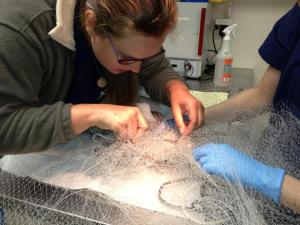
Helping a corn snake who is tangled in netting trash.
Super Horse: Whew! That makes me tired just reading about your day! You work so very hard! I hope you eat your veggies :)! How many animals do you treat a day?
Dr. Schneider: Each of the veterinarians will examine or recheck anywhere from 20 to 100 animals daily.
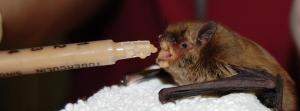
Feeding a bat!
Super Horse: That is a lot of animals! What type of animals do you see most (birds, mammals or reptiles)?
Dr. Schneider: Approximately 60%-70% of the animals admitted are birds, 30%-40% are mammals and the rest are reptiles.

Great Heron with fish hook in skin.
Super Horse: South Florida does have tons of birds! Spring is on its way and that means it is baby season. What advice do you have for people if they see a baby they think may be in need of help?
Dr. Schneider: Many of the orphans that are brought to us are not truly orphans because the parents are still close by. Make sure that you check carefully for a nest or parents before removing a baby animal. It is a myth that by touching a baby the mother will reject it afterwards. If it is truly sick or injured, or if you are really not sure, then it should be contained and brought to a wildlife rehabilitator.

Feeding a baby squirrel
Super Horse: That is great advice! Tell us about your favorite success story.
Dr. Schneider: There is not one single story that can express the joy of what we do. Last week we released 13 pelicans, 2 groups of hand-reared raccoons, 2 grey squirrels that were severely injured on arrival, a vulture that had surgery for a broken wing, amongst many others. We also re-united 2 baby screech owls with their mom in the existing nest in the tree after a tree-trimmer had frightened them into jumping out of the hole that they call home.
The sum of these releases week after week is the success story that keeps me here.
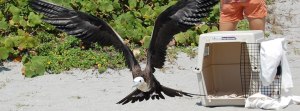
Bird release
Super Horse: Wow! You help so many animals in just one week! That makes you a super hero! How can people help their local wildlife this time of year?
Dr. Schneider: Most of the babies that are admitted are caught by a dog or a cat. Keeping pets away from wildlife is a good start. Keeping the yard free of trash and using bins that close tightly helps too. Never feed wildlife. We also have groups of baby raccoons that come in because the mother was relocated by a trapper. It is important to use humane trappers that keep families together. People should block holes in the roof and attic so that raccoons do not nest there. Finally, although it seems that spring is a good time to do tree trimming and yard work, many nests are disrupted by this activity and if you can wait or be cautious when tree trimming, it could save wildlife.
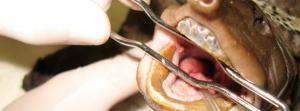
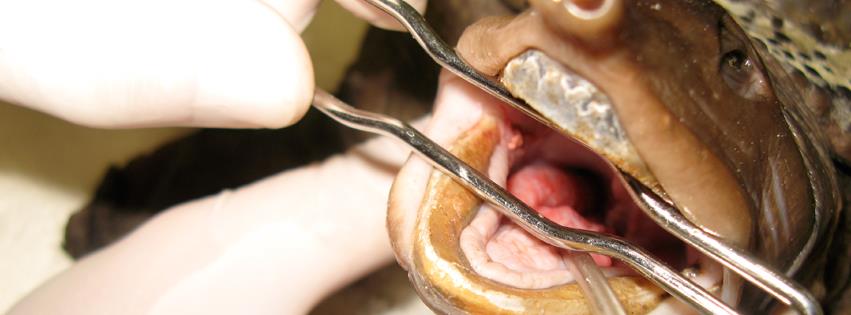
Looking at a soft shell turtle’s mouth
Super Horse: Great tips! We’ve never thought about tree trimming disturbing nests before. If someone wanted to become of wildlife rehabilator or volunteer, how would they start that process?
Dr. Schneider: In order to volunteer at the SFWC there is an application process and an orientation. If not here, find a local wildlife hospital or rehabilitator and volunteer with them. Do whatever is needed, even if it is washing dishes or doing laundry. Pay attention, read about the species that are seen there, learn how to handle the animals safely, attend any classes offered. The more time that you spend and the more dedicated you are; the more that you will be asked to do. Getting hands on experience with the animals comes after your trust has been earned. It takes a lot of time and patience to train volunteers to do the “fun” stuff. If you show that it is worth investing in you, you will be offered excellent experience. Each state is different, but in Florida after logging a certain number of hours doing wildlife rehabilitation, and passing a test, one can become a licensed rehabilitator.
Super Horse: Thank you so much for taking the time to talk to us! You can find out more information about South Florida Wildlife Center on their website and on Facebook. Check out this amazing organization and Dr. Schneider! They are true Wildlife Heroes!
Elephants & Horses love to share!
















 The Adventures of Ellie and Edmond