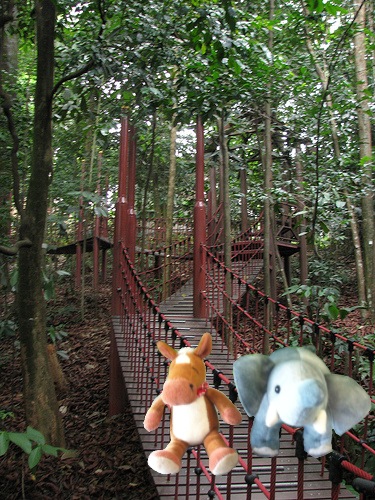
Posts Tagged With: science

Day 11- Back on the road

Day #11 (1/22/2014) Back on the road(and in the ocean)

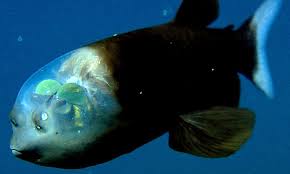
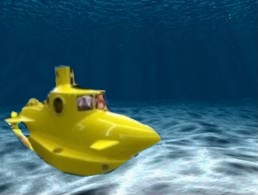
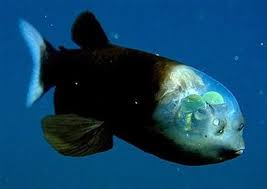
      We had a great weekend and really enjoyed celebrating Penguin Appreciation Day and Squirrel Appreciation Day! We spent the evening before deciding where we wanted to go this short week. We haven’t taken out the submarine in while, so we made the decision to do looking for a crazy looking fish! Packing up a submarine can be tricky, but luckily we have a great support staff. It’s always exciting to get lowered in to the water and find amazing species! Today’s fish is especially crazy! It’s the Barreleye!
e e deep sea

Their range and habitat: tropical-subtropical oceans/ worldwide

Their length: up to 4 ¼”    Their status: common

They are carnivores
barreleye

  • Barreleyes have upward facing and barrel shaped eyes.
  • They have spineless dorsal fin.
  • They have a light reflecting organ that makes the barreleye practically invisible from the underside.
  • Barreleyes are found in deep waters; as deep as 80m.
  • Barreleyes are toothless.

 barreleye2

You never known what two explorers will find when they go looking the oceans great depths. We know so little about the creatures that live in the largest habitat on earth. Ellie has a bit of claustrophobia, so after a few hours in the sub she is ready to come back to the surface. I myself could stay in there for hours and hours! Tomorrow is Guess the Animal and it’s one we spotted on our way back up to the surface!

-Edmond
Categories: adventure, Animals, Children, conservation, education, Environment, fish, nature, science, wildlife | Tags: , , , , , , , , , , | 1 Comment

SQUIRREL APPRECIATION DAY!!

SQUIRREL APPRECIATION DAY!!

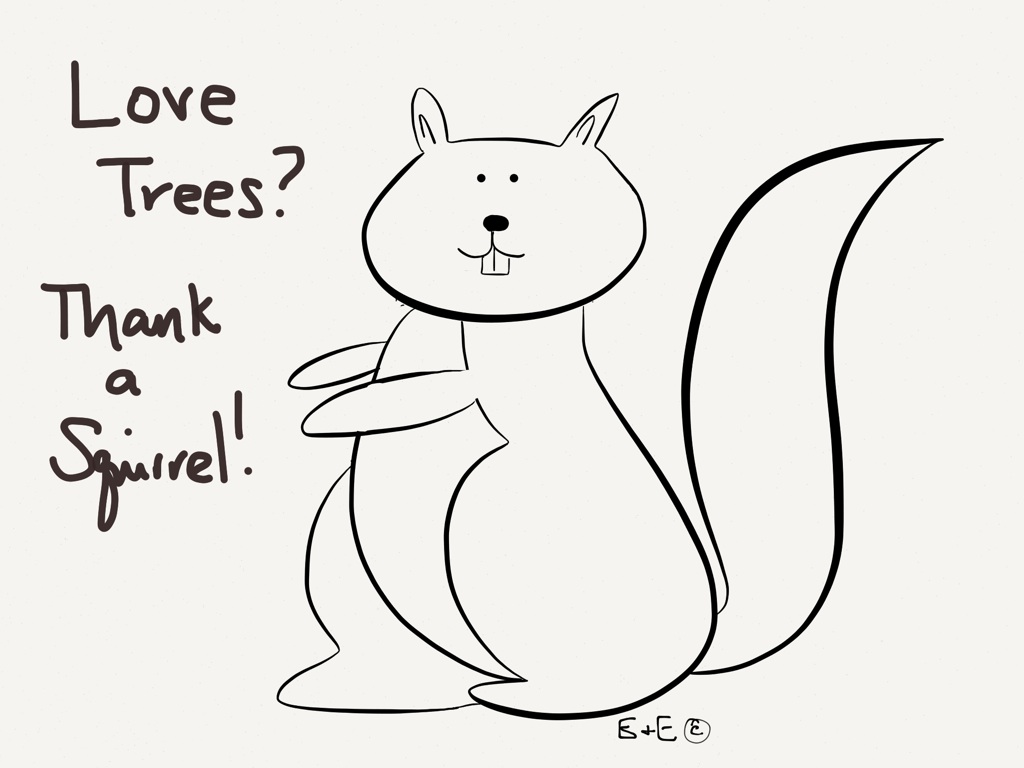
Who loves squirrels? We love squirrels!! These great little rodents are some of the best tree planters around! When squirrels stash their seeds and nuts for the winter, they often forget some and those seeds and nuts can grow into trees!

So if you love trees (and who doesn’t) then thank a squirrel! And enjoy our squirrel coloring sheet!

114

squirrel coloring sheet

Categories: adventure, Animals, Children, conservation, education, Environment, mammals, nature, science, squirrels, wildlife | Tags: , , , , , , , , , | 1 Comment

PENGUIN APPRECIATION DAY!!!

PENGUINS APPRECIATION DAY!!!

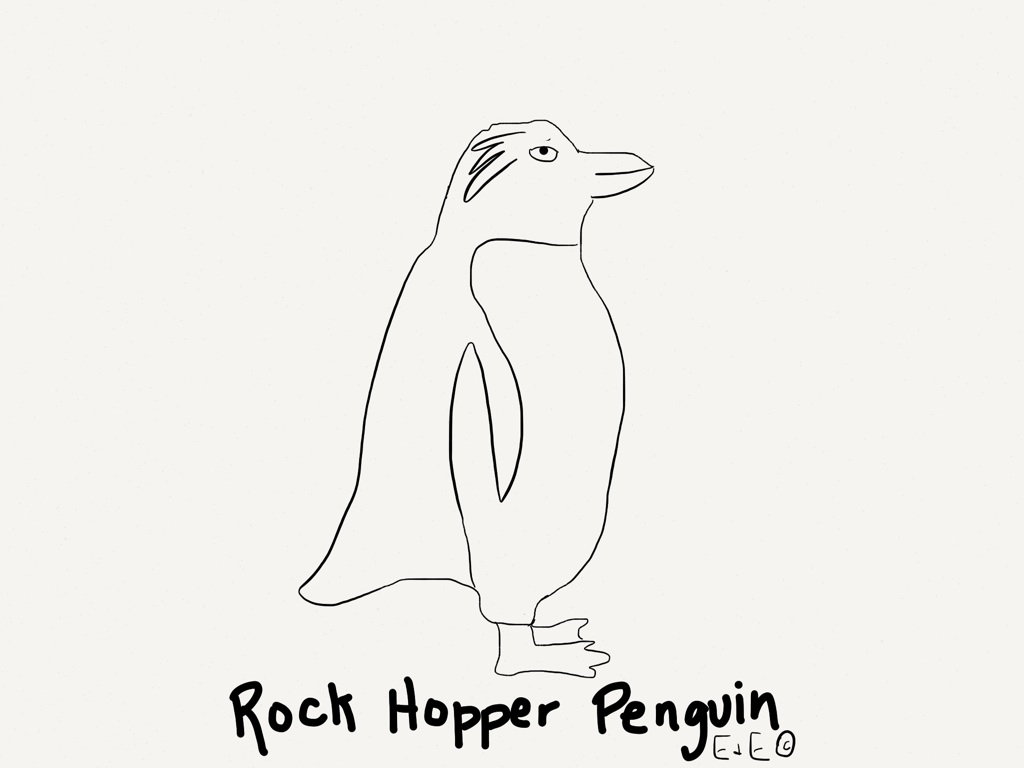
We’re celebrating everyone’s favorite flightless bird with two coloring sheets!

king penguin coloring sheet

rock hopper coloring sheet

Categories: adventure, Animals, birds, Children, conservation, education, Environment, nature, penguins, science, wildlife | Tags: , , , , , , , , , , | Leave a comment

University of E&E

University of E&E

 e e u graphic

Welcome new students to the University of E&E (where animals teach about animals)

We here at the University of Ellie and Edmond strive to teach as many as we can about animals. We want to instill a fascination, appreciation and respect for the animals that we all share this planet earth with. We want to introduce you to one of our most esteemed professors- Professor T. Tamandua! Professor Tamandua will be sharing the Science Word of the Week with you, along with 2 o’clock trivia that we post on Twitter, Facebook and Instagram during the week! (A tamandua is a lesser anteater. They live in South America and have a very strong odor to protect themselves.) Have a seat, sit back and let’s learn!

Professor Tamandua

 Hello students! I am so glad you could join me here at the University! Today’s word is Ectothermic!

Ectothermic (ek-tuh-thurm)   An animal that regulates its body temperature by using the outside environment. Fish, reptiles and amphibians are ectothermic. Invertebrates are also ectothermic. Another word for Ectothermic is Cold-Blooded.

Can you name some ectothermic animals?

 endothermic cartoon


TRIVIA!!

Here are the trivia questions for the week! Can you answer them all? (scroll down if you get stuck)

Squirrels cannot vomit. True of False

All species of armadillos can roll into balls when threatened. True or False

Naked mole rats are neither moles nor rats. True or False

A _________ has the longest hair of any mammal. A) musk ox B) polar bear C) arctic fox

Stingrays are related to ________. A) dolphins B) sharks C) tuna


False! Squirrels can vomit! Flying squirrels, rabbits, rats and horses are among the animals that cannot vomit though!

False! Only the 3 banded armadillos can roll into balls to protect themselves.

True. Naked mole rats are rodents, but not moles or rats. Time for a name change for the only mammal that lives in a colony with a queen!

A-Musk Ox have the longest hair of any mammal on earth! That keeps them warm in those cold arctic temps!

B- Sharks. Both rays and sharks are cartilaginous (their skeletons are made of cartilage) fish!


Thanks for stopping by for this week’s lesson! See you next Sunday!

Professor Tamandua.

Categories: adventure, Animals, Children, conservation, education, Environment, nature, science, Uncategorized, wildlife | Tags: , , , , , , , , | Leave a comment

Day 10- Greater Rhea

Day #10 (1/17/2014) Greater Rhea

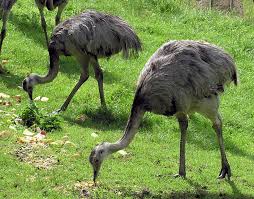
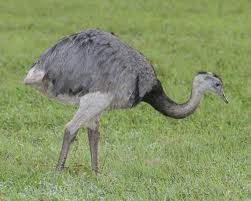
      We headed to the grasslands of Brazil to meet a relative of the ostrich. We were very excited, but we are getting tired and are ready to head back to HQs. Edmond’s oat and hay stew is yummy, but not after 3 nights. Hahaha! We found one last guide to take us out to meet a large flightless bird! We also saw a giant anteater out on the grasslands! We love anteaters and the Common Rhea!

e e grasslands

  • Their range and habitat: East-Southeast South America/ desert, grassland
  • Their length/weight: 3-5 ft/33-66 lbs   Their status: near threatened
  • They are omnivores (seeds, plants, fruits, lizards)

greater rhea3

  • Greater Rheas are large flightless birds.
  • They have 3 toes.
  • They live in groups.
  • Greater rheas are grey/brown in coloration. The males are darker.
  • Males do an impressive wing display during mating season.
  • Male greater rheas take charge of the incubation of the egg.

 greater rheagreater rhea2

What a wonderful afternoon! We watched a flock eat and rest and peck around! We even saw a male flapping his wings at some ladies. Breeding season must be coming soon! Too bad we will miss it. We’re packing up camp and have to run to catch the E&E plane back to HQs! Look for our new feature- University of E&E and Science Word of the Week on Sunday!

-Ellie and Edmond

Categories: adventure, Animals, birds, Children, conservation, education, Environment, nature, science, wildlife | Tags: , , , , , , , , , | 2 Comments

Day 9- Guess the Animal

Day #9 (1/14/14) – Guess the Animal

We stayed in Brazil today. We wanted to find a small, adorable little primate! We were so excited to find a family of them bounding through the trees! Can you guess who it is?

glt


  •          They live in the rainforest.
  •          They are orange in color.
  •          They are named after a large cat!

Who is it?

Ellie and Edmond

Categories: adventure, Animals, Children, conservation, education, Environment, mammals, nature, science, wildlife | Tags: , , , , , , , , , | Leave a comment

Day 8- Arapaima

 Day #8 (1/15/2014) Arapaima

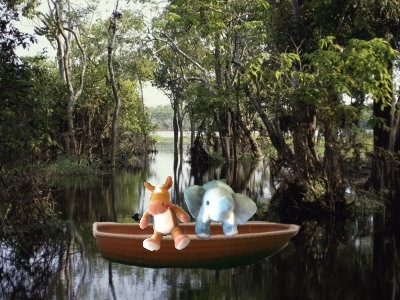
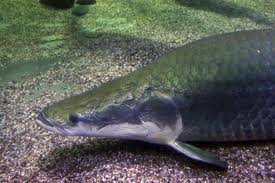
      We packed up camp and headed to Brazil to find a large fish! After a plane ride, we dropped off our stuff and headed straight over to the Amazon River. It didn’t take us long to find the giant we were looking for; they stay near the surface! You see the Arapaima breathes air!

e & e river boat

Their range and habitat: South America/ Amazon River

Their length/weight: 6-8 ft/200-400lbs  Their status: unconfirmed

They are carnivores (fish, crustaceans)

arapiama

  • Arapaimas have long torpedo shaped bodies.
  • They have large scales.
  • Arapaimas’ fins are placed towards the back of their bodies.
  • Arapaimas feed at the surface.
  • They breathe at the surface air. Their swim bladder acts like a lung.

 arapiama2

Watching the arapaimas all day wore us out! We had such fun on the boat. There are so many things to see in the Amazon River. We could spend weeks here! Thank goodness we packed our MUD bug repellant! The insects down here are nuts! Edmond spent his evening scratching his bum on a tree!

-Ellie and Edmond

Categories: adventure, Animals, Children, conservation, education, Environment, fish, nature, science, wildlife | Tags: , , , , , , , , , | Leave a comment

Day 7- Common Boa

Day #7 (1/14/2014) Common Boa

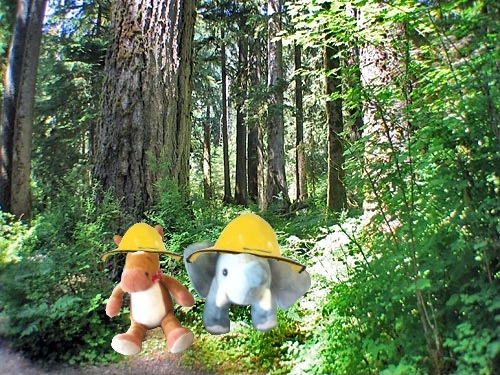
      We spent our day in the rainforest again. This time we had our guide help us find a reptile. Many of us have seen this snake in zoos and nature centers, but we really want to see one in the wild. It took us quite a while to locate this snake because their camouflage is amazing! We finally spotted one late in the afternoon!

e & e rainforest

Their range and habitat: Central-South America/forest, desert, grasslands

Their length:  3 ¼-13 ft  Their status: common

They are carnivores (small mammals, birds)

common boa

Common Boas vary in color depending on their habitat.

They are up to 10 subspecies.

Common boas are excellent climbers.

They are constrictors.

Common boas are nocturnal.

common boa2


It was such a fun adventure to look for the common boa today! Trying to spot an animal who has amazing camouflage made for such a great day. You must be on the lookout at all times! We’re glad we spotted one in a tree and not up close. We’re going to end the day with some apple cider and smores at camp!

-Ellie and Edmond

Categories: adventure, Animals, Children, conservation, education, Environment, nature, reptiles, science, wildlife | Tags: , , , , , , , , , | Leave a comment

DAY #6- Bolivian Squirrel Monkey

Day #6 (1/13/14) Off to South America

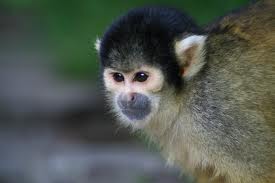
      We had a lovely weekend back at HQs. We decided to spend the second week of our trip in South America. We packed our trunk full of supplies and headed to the rainforest for the day. After we set up camp, we met up with a guide who walked us through the rainforest. We saw so many animals, but we were on the lookout for just one! After much searching we saw the little primates we were looking for! We sat very still and watched the agile Bolivian Squirrel Monkey for hours!

e & e rainforest2

bolivian squirrel monkey3

  • Their range and habitat: West to Central South America/rainforest

bolivian map

  • Their length/weight: 10 ½-12 ½“/ 34 oz Their status: common
  • They are omnivores (insects, fruits, seeds)
  • Bolivian Squirrel Monkeys are subspecies of the black-capped squirrel monkey.
  • Bolivian squirrel monkeys live in large troops (40-50 individuals).
  • Their tails are longer their bodies. They have bushy black tips on those tails.
  • Bolivian squirrel monkeys have furry ears.
  • They have white fur around their eyes.
  • Bolivian squirrel monkeys are arboreal.

   bolivian squirrel monkey2 bolivian squirrel monkey

We had such a blast watching these special monkeys! They are so fast! We could watch the troop for days. Primates are so amazing. They’re social, intelligent and in the case of the Bolivian Squirrel Monkey- amazing and agile climbers! Our first day here in the rainforest has been great. We’re going to wrap up the night at base camp with a game of cards and some oat cookies! See ya tomorrow!

-Ellie and Edmond

Categories: adventure, Animals, Children, conservation, education, Environment, mammals, nature, science, wildlife | Tags: , , , , , , , , , | Leave a comment

Science Word of the Week- #1

SCIENCE WORD OF THE WEEK!

We’re starting our new feature this week! We’ll be featuring a science word of the week with a cartoon!

This week’s word: Endothermic

Endothermic or Warm Blooded refers to animal whose body maintains its own body temperature (usually above the temperature of its surroundings). Endothermic animals must intake calories everyday to help them maintain this body temperature. All mammals and birds are endothermic.

endothermic cartoon

Categories: adventure, Animals, birds, Children, conservation, education, Environment, mammals, nature, science, wildlife | Tags: , , , , , , , , , , | 1 Comment

Blog at WordPress.com.