Animals

Amphibian Friend at Lake Salamander

Amphibian Friend at Lake Salamander

We are so happy to meet our first friend of the summer! Camp E&E sits next to one beautiful lake- Lake Salamander. This special spot was named because of the special amphibians who live here! We are always so thrilled to find a few chilling in the woods.

Today we are meeting the Southern Zigzag salamander. Woohoo!
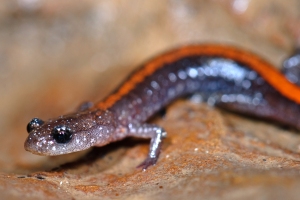
03895B5D-FD41-4D4B-ADFC-8D73BB7270AD

Southern Zigzag Salamander Fun Facts: 

  • These adorable amphibians are carnivores. They eat mostly insects.
  • They only grow to about 3 1/2 inches long! Not a big animal for sure.
  • They call the forest floor their home, so watch where you are stepping while on hikes campers.
  • They have a zigzag stripe down their back. It can vary in color from red to yellow.
  • Females lay eggs in burrows. They guard their eggs until they hatch. Unlike a lot of salamanders, they do not go through an aquatic larva phase. When they are born, they look like miniature adults!
  • They are listed by the IUCN as Least Concern.

Can you imagine how cute teeny tiny zigzag salamanders are? We would hardly be able to stand it! We hear that Crafty Crab is coming up with a cute salamander craft later in the week! YAY!

Categories: adventure, amphibians, Animals, camp, Children, conservation, education, Environment, nature, science, Today's Post, wildlife | Tags: , , , , , , , , , , , | 1 Comment

Camp E&E 2018

Camp E&E Summer 2018

7552C7CF-F69D-4A02-98D4-96F37172AEBF


Hello and welcome to Camp E&E this summer! We have a great line-up this year with animals, camp fire stories, interviews, crafts and more!

We are spending June here at our home base next to Lake Salamander! There are so many animals to meet that call these woods home all year round . Some are small but mighty and some are scary to most people, but they all are special and they are ready to welcome us all to camp.

In July, we’ll be heading to beach camp to meet sea creatures and shore birds. By August you’ll not want to leave!

So campers- it’s time to pack your bags and get your cabin assignment. Camp E&E is kicking off summer of 2018.

Packing list:
Sheets
Flashlight
Bug spray
Hiking shoes
Water shoes
Swimsuits or trunks
Mud SPF 50 sunscreen
Your favorite stuffed animal to sleep with
Sleeping bag
Refillable water bottles
Swim goggles
Binoculars
Nature journal

0F9AAAB1-0DDC-42AE-A672-81CE65A4487A


We’ll meet our first animal tomorrow!

Categories: adventure, Animals, camp, Children, conservation, crafts, education, Environment, nature, science, Today's Post, wildlife | Tags: , , , , , , , , , | 1 Comment

School’s Out

School’s Out

We are taking the next few weeks off to get ready for Camp E&E to start on June 4th. We sincerely apologize for our intermittent posts over the last month or so. Things have been a bit hectic and we are hoping life slows down as summer rolls in and after our much need vacation in the Pacific Northwest!

Get your camping gear ready and your Mud SPF 50 packed so we can enjoy an wonderful summer together at Camp E&E!

Categories: adventure, Animals, camp, Children, conservation, education, Environment, nature, science, Today's Post, wildlife | Tags: , , , , , , , , , | 1 Comment

Black & White Bird

Black & White Bird

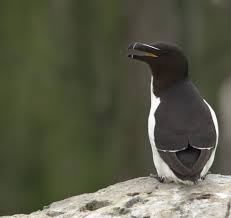
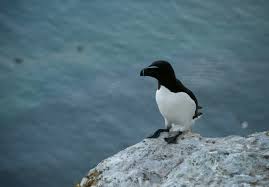
As we were exploring the cliffs and coasts to meet puffins, we met another neat sea bird- the razorbill! These neat looking birds look even more formal than penguins!

razorbills

Razorbill Fun Facts:

  • They grow up to 8 1/2 inches long and weigh up to 30 oz.
  • These carnivores eat fish and crustaceans.
  • These sea birds spend most of their life at sea. They spend time on cliffs and coastlines to breed in the spring.
  • Male and females mate for life. They come together to incubate the egg.
  • The oldest living razorbill lived to 41 years.
  • They are listed as Least Concern by the IUCN.

razorbills2

These gorgeous birds are so cool! They have the neatest little white lines on their beaks. They are quiet fun to watch dive for food.

Categories: adventure, Animals, birds, Children, conservation, education, Environment, nature, science, Today's Post, wildlife | Tags: , , , , , , , , , , , | 1 Comment

Puffins!!

Puffins!

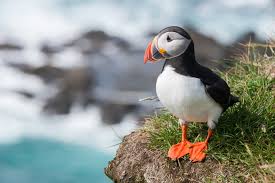
We headed to the coast line to meet one of the most iconic birds of Norway’s coastline- the Atlantic Puffin! These adorable birds are so much fun to watch. We wish one would come live with us the University.

puffin

Atlantic Puffin Fun Facts:

  • These little handsome birds grow up to 10 inches long and can weigh up to 17 oz.
  • They are nicknamed the “sea parrot”.
  • These carnivores eat fish.
  • Their brightly colored beaks are duller in color during the winter. They bright colors are brightest during breeding season.
  • These sea birds spend most of their life at sea. They can swim under water using a flying motion. They can even dive up to 200 feet deep.
  • In the air, they can fly up to 55 mph.
  • Both parents incubate the egg and then feed the chick.
  • They are listed as Vulnerable by the IUCN.

puffin2

These amazing birds form large breeding colonies. They breed in the same place every year. Scientists are not sure how the birds navigate back to the same place yet.

Categories: adventure, Animals, birds, Children, conservation, education, endangered species, Environment, nature, science, Today's Post, wildlife | Tags: , , , , , , , , , , | 1 Comment

Large Lynx

Large Lynx

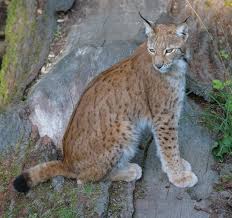
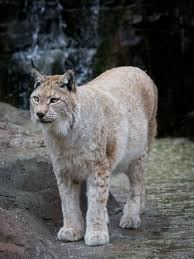
We met a neat cat today here in Norway! There are lynx in America, but the ones that call Europe home are the biggest members of the lynx family. Come learn more about them with us.

lynx

Eurasian Lynx Fun Facts:

  • These cats can grow up to 51 inches long and weigh up to 66 pounds.
  • These carnivores eat mammals, including small mammals and larger prey like reindeer.
  • Their back legs are slight longer than the front ones.
  • They are crepuscular- active at dusk and dawn.
  • Males occupy a large territory. There are several females living within that territory. That are usually solitary.
  • They have dense fur to keep them warm in the winter months. Longer fur grows on their paws to help them walk in snow.
  • Eurasian lynx are listed as Least Concern by the IUCN.

lynx2

These cats are quiet the predators. They can take down prey much bigger themselves. We love their ear tufts and big paws!

Categories: adventure, Animals, Children, conservation, education, Environment, mammals, nature, science, Today's Post, wildlife | Tags: , , , , , , , , , , | 1 Comment

We’re in Norway

We’re in Norway

If you guessed Norway for our next adventure- you were right!! Come learn more about this amazing place with us today!

51F1B905-6346-4DAC-B184-3A911F47CB8E

Norway Fun Facts: 

  • The deepest lake in Europe is in Norway- lake Hornindalsvatnet.
  • Norway has the longest coastline in Europe.
  • Norway is home to the largest glacier in Europe.
  • Norway is the largest exported of salmon.
  • Norway is home to many fjords. Fjords are deep inlets of seas between cliffs.
  • The Sami are the indigenous people of Norway. They have lived their for 10,000 years. They are most known for their reindeer herding.

We are so excited to meet some animals that call Norway home! We hope you are too!

Categories: adventure, Animals, Children, conservation, education, Environment, nature, science, Today's Post, wildlife | Tags: , , , , , , , , | 1 Comment

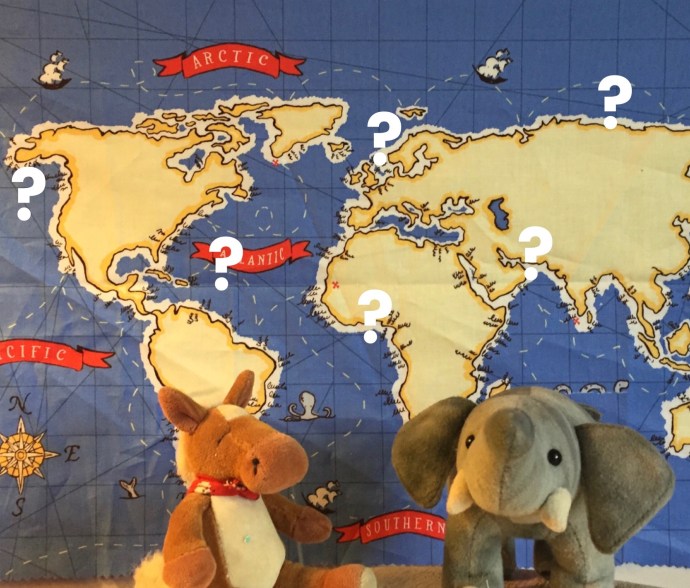
Where Will the Next E&E Adventure Be?

Where Will the Next E&E Adventure Be?

We are heading out on last adventure for the year! Are you ready to learn in May? Then we’ll be heading out to Camp E&E for the summer! Woohoo!

We are heading to Europe and a land near the Arctic Circle.

Is it the home of the largest deep water coral reef.

There are over 15,000 miles of coastline. 

It is a land of polar bears, salmon and large glaciers.

You can’t miss the fjords. 

Can you guess where our next adventure be? 


Categories: adventure, Animals, Children, conservation, education, Environment, nature, science, Today's Post, wildlife | Tags: , , , , , , , , , | 1 Comment

We Spots a Spotted Owl

We Spots a Spotted Owl

When people think of Africa, people think of all the big animals, but rarely do they think of owls! Well, Africa is home to many species of owls. We went looking for the Spotted Eagle and we found one! Come learn more about them with us!

spotted eagle owl

Spotted Eagle-Owl Fun Facts:

  • Spotted eagle-owls have a 3 foot wing span!
  • They have large ear tufts and bright yellow eyes.
  • Like many owls they are nocturnal.
  • These carnivores eat mammals, birds and amphibians. They are also known to eat carrion.
  • Spotted eagle-owls are known to bond for life.
  • They are listed as Least Concern by the IUCN.

spotted eagle owl2

Seeing an owl in the wild is always a treat! These owls have a fun musical call. We could listen to them all night.

Categories: adventure, Animals, birds, Children, conservation, education, Environment, nature, science, Today's Post, wildlife | Tags: , , , , , , , , , , , , | 1 Comment

Hello Antelope!

Hello Antelope!

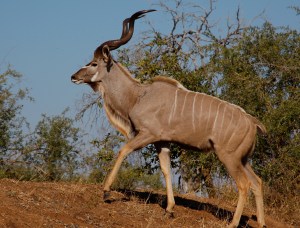
Happy Monday and we are so excited for you to meet the animal we spotted this weekend. They have some fantastic antlers! Are you ready to meet the kudu?

Kudu,_Living_Desert_3-15_(16792801682)

Greater Kudu Fun Facts:

  • Greater Kudu can grow up to 96 inches long and weigh up to 700 pounds.
  • Only the males have those impressive spiral horns.
  • Those horns can grow up to 3 feet long!
  • They have a crest of fur that runs down their back.
  • They live in family groups that consist of females and their offspring. The males are solitary or live in small bachelor groups.
  • These herbivores eat vegetation, fruit and grasses.
  • Greater kudu are listed as Least Concern by the IUCN.

Male_greater_kudu

It was fun to spot some males with their spectacular antlers! Can you imagine having those attached to your head all the time?

Categories: adventure, Animals, Children, conservation, education, Environment, mammals, nature, science, Today's Post, wildlife | Tags: , , , , , , , , , | 1 Comment

Blog at WordPress.com.