fish

A Fish with a Bite!

A Fish with a Bite!

img_2322red-pirahna3


ellie_edmund_professors-seahorse(1)


Date: 9/26

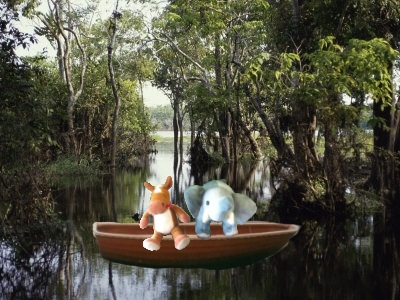
Location: Amazon River

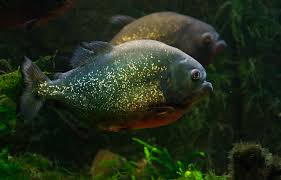
  • Red Bellied Piranha  are also known as red piranha.
  • They live in shallow waters of the Amazon river.
  • Red bellied piranha have a mouth full of triangular sharp teeth.
  • They can bite with enormous force.
  • Red bellied piranha rarely feed in groups. Feeding frenzies are rare.
  • If a feeding frenzy does take place, it happens when the fish are starving.
  • Attacks on humans are rare.
  • Red piranha make sounds using muscles associated with their swim bladder.

img_2329

  • They use these sounds to communicate with each other.
red-pirahna2red-pirahna

Piranha have such a bad reputation, but that is mostly a myth. They are mostly solitary and they even eat nuts and seeds! We learned quiet a bit about these misunderstood fish on our boat trip today. Tomorrow we head up in to the cloud forest to meet a tiny amphibian.
Categories: adventure, Animals, Children, conservation, education, Environment, fish, nature, science, Today's Post, wildlife | Tags: , , , , , , , , , | Leave a comment

ONE BIG FISH!

ONE BIG FISH!

img_2134 arapiama3


ellie_edmund_professors-seahorse(1)


We had to head back to the University for a few days last week to honor one of our dear students who we lost. We’re back in the Amazon Rainforest today to meet a large fresh water fish- the arapaima.

arapiama

Date: 9/19

Location: Amazon Rainforest

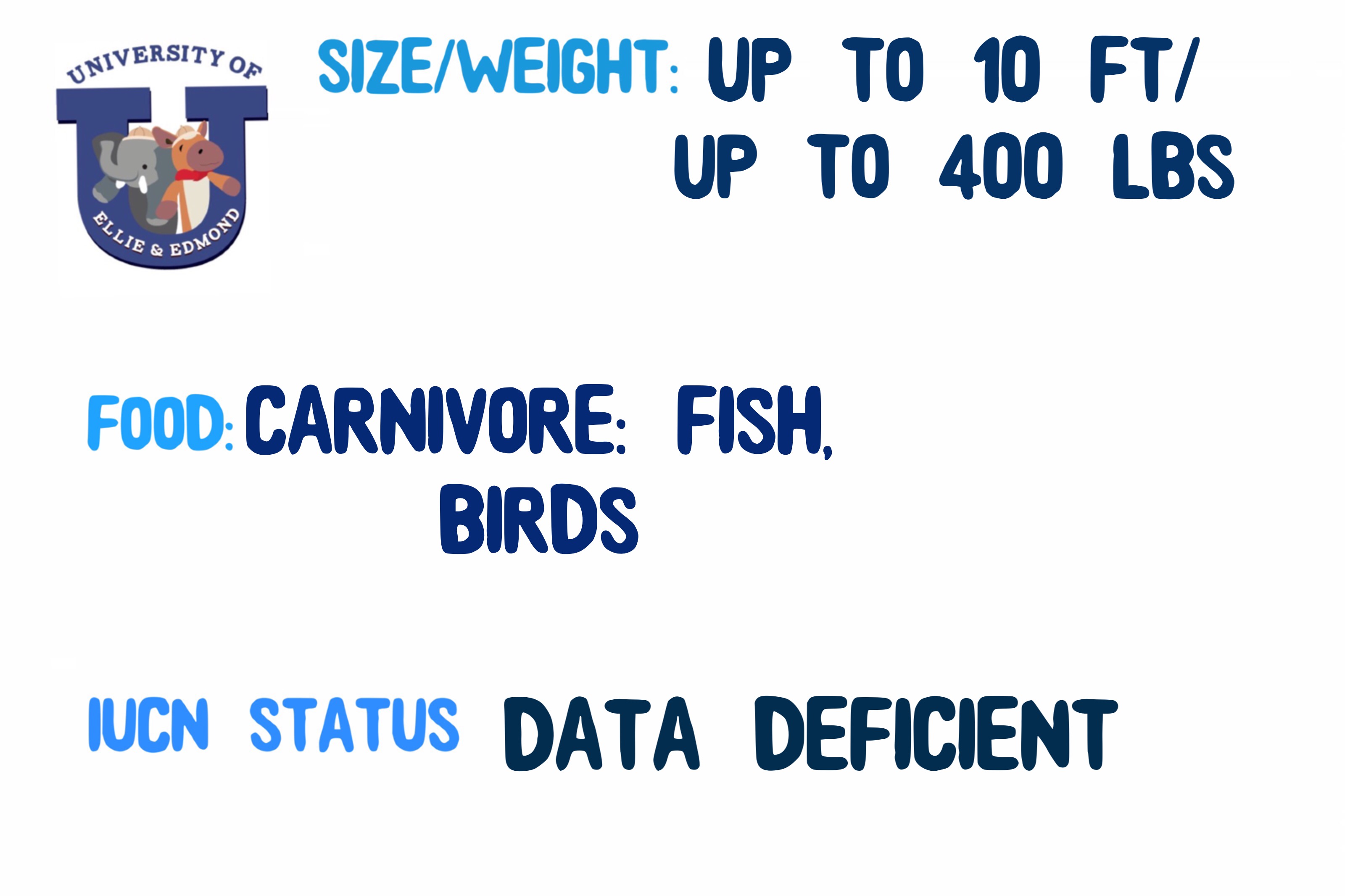
Arapaima Facts:

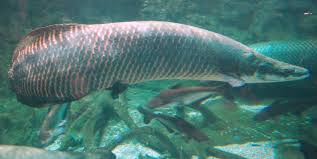
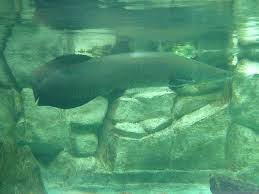
  • Arapaima have long torpedo shaped bodies.
  • Arapaima scales are hard, heavy and are covered in minerals. These help protect them.
  • They are the largest fresh water fish on earth.

img_2136

  • They do have gills, but use a specialized organ to breathe air from the surface too.
  • They come to the surface every 5 to 15 minutes to breathe.
  • Male arapaima protect the babies in their mouths until they are big enough to protect themselves.
  • Arapaima have bony tongues.
  • While they are listed as data deficient by the IUCN, they are listed as endangered by CITES and are protected from over fishing.

img_2135arapiama2


Arapaima are amazingly cool fish! Did you know there were fish that breathed air too? Isn’t that neat? It’s a great adaptation to have when you live in water that may not be very oxygen rich. We’re off to meet some new friends tomorrow!

Categories: adventure, Animals, Children, conservation, education, Environment, fish, nature, science, Today's Post, wildlife | Tags: , , , , , , , , , | Leave a comment

That’s No Piranha!

That’s No Piranha!

pacuimg_1859


ellie_edmund_professors-seahorse(1)


Date:9/12

Location: Amazon river


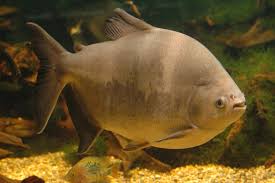
  • Pacu are fresh water fish.
  • They are related to piranha, but they are not carnivores like piranha.
  • They grow much larger than piranha.
  • Young pacu look very similar to piranha and will hide in schools of piranha for protection. Once they are bigger they will go off on their own.
  • They have flat molar like teeth. Pacu use those teeth to crush nuts.

pacu2

  • These teeth are famous for their human like appearance, which can be startling. 
  • Pacu are popular fish in the pet trade.
  • They are sold as small fish, but grow larger than expected and are then released into wild habitats where they don’t belong. They have been found in Southeast Asia, parts of North America and even in the UK.
  • It is illegal to dump non-native wildlife in most of those places and the Pacu can out compete local fish and wildlife.

pacu3

We enjoyed taking a boat down the Amazon river to see some of the amazing animals that call it home! We spotted several pacu and some other creatures who’ll meet later this week! This place is awesome!

e-e-river-boat

Categories: adventure, Animals, Children, conservation, education, Environment, fish, nature, science, Today's Post, wildlife | Tags: , , , , , , , , | Leave a comment

SYLVIA THE SEAHORSE!

SYLVIA THE SEAHORSE!

ellie_edmund_professors-seahorse(1)

Hi everyone! I’m Sylvia the Seahorse! I’m the last of the new professors to introduce myself here at the University of Ellie and Edmond! I’m named after Sylvia Earl, the famous ocean explorer! I’ll be here to teach you all about the fish of the world’s oceans and freshwater habitats. Fish come in all sizes and shapes and we live at the very deepest parts of the oceans to the rivers at the tops of mountains! Some of us are colorful and oddly shaped and others of us are plain.
Most people don’t know that I am a fish, but I am! I live in the Great Barrier Reef off the coast of Australia! I’m not the strongest swimmer as my dorsal fin is very small, so I stay close to the corals, where I hang on with my tail. I eat small plankton and crustaceans that I suck into my snout. I must constantly eat because I have no stomach. I can eat up to 3,000 shrimp a day! They sure are tasty. I have a mate who incubates our young. That’s right the male seahorse has a pouch that he carries the eggs in until the hatch.
I am so excited to share more about myself and my fish friends here at The University! I hope you’re excited too!

Categories: adventure, Animals, Children, conservation, education, Environment, fish, nature, science, wildlife | Tags: , , , , , , , , , , | 1 Comment

WHALE SHARK DAY!!

WHALE SHARK DAY!!

 whale shark2

Today it International Whale Shark Day! So let’s celebrate these gentle giants of the oceans!

  • Whale sharks are the largest fish in the oceans!
  • They are sharks, with full cartilaginous skeletons!
  • Whale sharks are filter feeders! They eat plankton that they filter out of the water.

IMG_3785

  • Whale sharks prefer temperate to tropical waters.
  • Whale sharks are listed as vulnerable on the IUCN list.
  • Whale sharks can live up to 70 years!
  • Every whale shark has a unique spot pattern.
  • Whale sharks are classified as carpet sharks, which include nurse sharks and our favorite the wobbegong!

whale sharks

IMG_3786


Answer: A) 3 feet

Categories: adventure, Animals, Children, conservation, education, Environment, fish, nature, oceans, science, wildlife | Tags: , , , , , , , , , , | 3 Comments

Day 41- we meet a puffer fish…

Day #41 (7/16/2014) Dogface Pufferfish…

e & e snorkeling

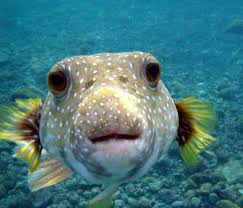
We went snorkeling at the Great Barrier Reef yesterday and spotted so many kinds of animals, from fish to crustaceans to cephalapods. We saw a curious funny faced fish. We realized it was a pufferfish and not just any pufferfish- a dogface pufferfish!
puffer fish
Their range/habitat: Indo-Pacific oceans/ coral reefs
Their length: 3-12″  Conservation Status: common
Their diet: Omivores– algae, seaweed, sponges

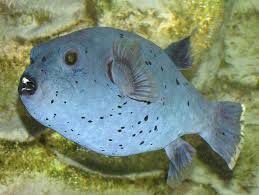
• Dogface pufferfish are also known as the blackspotted puffer.
• They have no pelvic fin.
• Dogface pufferfish are solitary and territorial.
• Dogface pufferfish to have toxins.
• They will puff up when threatened.
dog face puffer fish2

We were so excited to see this special fish with the dog like face! Puffer fish get a bad rap; who knew they could be so cute? We’re going to bed for the night, it is exhausting snorkeling all day! More adventures tomorrow!

-Ellie and Edmond


Categories: adventure, Animals, Children, conservation, education, Environment, fish, nature, science, Uncategorized, wildlife | Tags: , , , , , , , , , , | 1 Comment

Day 27- Guess the Animal!

Day #27 (3/13/14) – Guess the Animal

We just had to snorkel at the Great Barrier Reef while we were in Australia! We spotted this little fish! Can you guess?

clownfish


  •          This fish lives in coral reefs.
  •          They live with an anemone.
  •          They are brightly colored.

Who is it?

Ellie and Edmond


Categories: adventure, Animals, Children, conservation, education, Environment, fish, nature, science, wildlife | Tags: , , , , , , , , , , | Leave a comment

Day 21- Tomato Clownfish

Day #21 (2/20/2014) Tomato Clownfish

      We spent our first full day in Southeast Asia snorkeling in a gorgeous reef. We were looking for an anemone fish. Most people know the clownfish from “Finding Nemo”, but most don’t realize that there are other species of anemone fish! We had a great time snorkeling and checking out this city under the water. Reefs are amazing places of diversity and color! We did find the fish we were looking for and it was the Tomato Clownfish!

e & e snorkeling

Their range and habitat: West Pacific/ coral reefs

Their length: 3-5 ½”   Their status: common

They are omnivores. (plankton and algae)

tomato clownfish3

  • Tomato clownfish live with a sea anemone.
  • They have a protective mucus to protect them from the anemones stings.
  • Tomato clownfish have one white stripe.
  • A family of tomato clownfish will live in one anemone.
  • Male tomato clownfish will turn into a female when the dominate female dies.

tomato clownfish2   tomato clownfish


We just love coral reefs and time passes so quickly when you are immersed in watching all that is happening there. Tomato clownfish and their anemones make up a small part of a huge ecosystem that is rich and wonderful. We must come back here!

-Ellie and Edmond

Categories: adventure, Animals, Children, conservation, education, Environment, fish, nature, science, wildlife | 2 Comments

Day 12- Guess the Animal

 Day #12 (1/23/14) – Guess the Animal

We’re having trouble with the internet out here on our boat. It makes it hard to post. Good thing we head back to land this afternoon. We saw the most amazing fish yesterday in the sub and as we headed back to the surface we spotted a school of these fish. Read the clues and tell which fish you think it is!

hammerhead


  •          They are a cartilaginous fish.
  •          They can be seen in schools or alone.
  •          They are named after a tool.

Who is it?

Ellie and Edmond

Categories: adventure, Animals, Children, conservation, education, Environment, fish, nature, science, wildlife | Tags: , , , , , , , , , , | Leave a comment

Day 11- Back on the road

Day #11 (1/22/2014) Back on the road(and in the ocean)

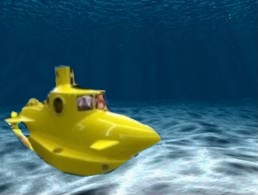
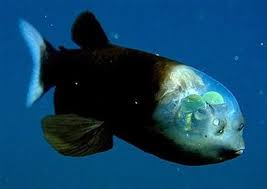
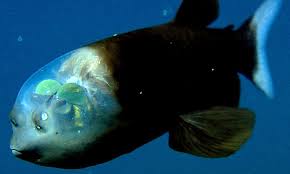
      We had a great weekend and really enjoyed celebrating Penguin Appreciation Day and Squirrel Appreciation Day! We spent the evening before deciding where we wanted to go this short week. We haven’t taken out the submarine in while, so we made the decision to do looking for a crazy looking fish! Packing up a submarine can be tricky, but luckily we have a great support staff. It’s always exciting to get lowered in to the water and find amazing species! Today’s fish is especially crazy! It’s the Barreleye!

e e deep sea

Their range and habitat: tropical-subtropical oceans/ worldwide

Their length: up to 4 ¼”    Their status: common

They are carnivores

barreleye

  • Barreleyes have upward facing and barrel shaped eyes.
  • They have spineless dorsal fin.
  • They have a light reflecting organ that makes the barreleye practically invisible from the underside.
  • Barreleyes are found in deep waters; as deep as 80m.
  • Barreleyes are toothless.

 barreleye2

You never known what two explorers will find when they go looking the oceans great depths. We know so little about the creatures that live in the largest habitat on earth. Ellie has a bit of claustrophobia, so after a few hours in the sub she is ready to come back to the surface. I myself could stay in there for hours and hours! Tomorrow is Guess the Animal and it’s one we spotted on our way back up to the surface!

-Edmond

Categories: adventure, Animals, Children, conservation, education, Environment, fish, nature, science, wildlife | Tags: , , , , , , , , , , | 1 Comment

Blog at WordPress.com.