Posts Tagged With: children

We Call Fowl!

We Call Fowl!

We met our last animal of our visit to the Great Victorian Desert! We will be heading to the coral reefs of the Raja Ampat Islands for the last month of the school year! We can hardly wait! And then- we head off to Camp E & E for the summer- where you are all invited!
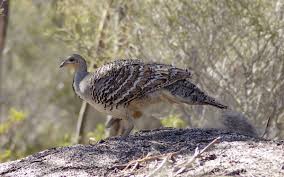
malleefowl

IMG_3828


Date: 4/27

Location: Great Victorian Desert

Malleefowl Fun Facts:

  • Malleefowl tend to stay on the ground. They only fly when threatened.
  • They are distantly related to chickens.
  • Malleefowl are mostly solitary.
  • Malleefowl can also freeze when they spot a predator, causing them to blend in with their surroundings.
  • Males build large nest mounds on the ground. The building is complicated and it done so the eggs are kept at a constant temperature.
  • Chicks are born in their underground nest and must dig their way out when they hatch. It can take 2-15 hours for the chick to reach the surface.
  • Chicks tend to hatch one at a time and then they do not interact with the adults or their siblings.

IMG_3829

We spotted a few of these stout birds and they do indeed stop motionless when they see you! It’s amazing that the little chicks have to survive with no parental help or care!
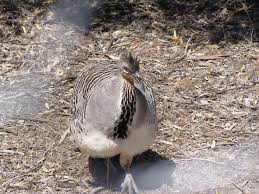
malleefowl2

Categories: Animals, birds, Children, conservation, education, Environment, nature, science, Today's Post, wildlife | Tags: , , , , , , , , , , | 1 Comment

What’s a Bibly?

What’s a Bibly?

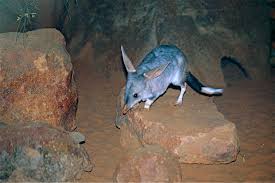
We headed out to find one of Australia’s neatest little animals! These crazy looking marsupials are so cool and we couldn’t believe we met one! Are you ready to meet them too?

bilby3

IMG_3826


Date: 4/26

Location: Great Victorian Desert

Greater Bibly Fun Facts:

  • Greater biblies are also known as bandicoots.
  • Bilbies have long snouts, large ears, back legs like a kangaroo and black & white tails! In other words- they are crazy looking!
  • They are nocturnal.

IMG_3827

  • Greater biblies are mostly solitary.
  • Their pouches face backward to keep dirt out of it.
  • Greater bilbies do not drink water, they get all the moisture they need from the food they eat.

bilby2

bilby


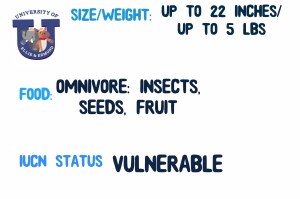
Bilbies are neat little critters! They are listed as vulnerable though. Again, their populations have dropped from predation from animals such as fox and feral cats. There are great conservation efforts happening to reintroduce bilbies in habitats where they were once gone.

Categories: adventure, Animals, Children, conservation, endangered species, Environment, marsupial, nature, science, Today's Post, wildlife | Tags: , , , , , , , , , | 1 Comment

The Parrot with a Crown!

The Parrot with a Crown!

We met a feathered friend in the outback! This shy green bird is not always easy to spot, but we were lucky!

princess parrot2

IMG_3813


Date: 2/25

Location: Great Victorian Desert

Princess Parrot Fun Facts:

  • Princess parrots were named after Princess Alexandra of Denmark.
  • They are quiet colorful, with bluish heads, pink throats and blue tails.
  • Males have longer tails and brighter colors than females.

IMG_3814

  • They make loud calls.
  • Princes parrots are known to live around 30 years.

princess parrot

We were so excited to find a few of these chatty little birds! They tend to gather in a group for mating and then disappear again!

Categories: adventure, Animals, birds, Children, conservation, education, endangered species, Environment, nature, science, Today's Post, wildlife | Tags: , , , , , , , , , | 1 Comment

Hello Wallaby!

Hello Wallaby!

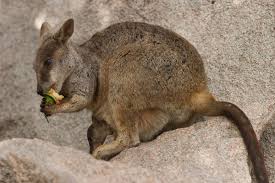
We met one of the cutest inhabitants of the desert today! These hopping marsupials are so fun! Let’s learn more about the Brush-tailed rock wallaby!

rock wallaby

IMG_3811


Date: 4/24

Location: Great Victorian Desert

Brush-tailed Rock Wallaby Fun Facts:

  • Brush-tailed Rock Wallabies have rough padded feet to help them get around the rocky terrain.
  • They live in groups where each animal has their own territory. One male’s territory overlaps several female’s territory.
  • Brush-tailed rock wallabies are crepuscular (active at dawn & dusk).

IMG_3812

  • Those long tails help them balance on the rocky habitats.
  • They find shelter in caves or rocky crevices.

rock wallaby2

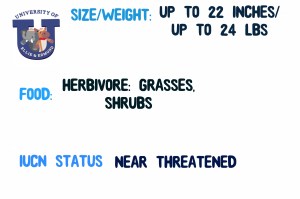
Rock wallaby’s are just the cutest! They are threatened due to habitat lose and the introduction of the non-native red fox. Ecosystems are very delicate and invasive species can quickly destroy it.

Categories: adventure, Animals, Children, conservation, education, endangered species, Environment, nature, science, Today's Post, wildlife | Tags: , , , , , , , , , , | 1 Comment

Monitoring a Monitor!

Monitoring a Monitor!

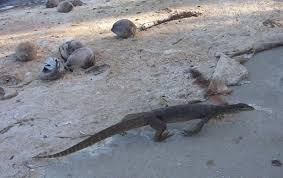
We went looking for a medium sized reptile today! We found this gorgeous animal and it was so fun to watch!

sand monitor

IMG_3689


Date: 4/19

Location: Great Victorian Desert

Sand Goanna Fun Facts:

  • Sand goannas are members of the monitor family.

IMG_3690

  • Sand goannas are burrows. They dig burrows for shelter.
  • They are diurnal (active during the day).
  • They have forked tongues to help them “smell” the air.
  • Sand goannas sense of smell is so good they can find buried prey.
  • Sand goannas lay their eggs in a termite mound. The termites keep the eggs warm.

sand monitor2

These monitors are so cool to watch! Other members of the monitor family include the famous Komodo dragon!

Categories: adventure, Animals, Children, conservation, education, endangered species, nature, reptiles, science, Today's Post, wildlife | Tags: , , , , , , , , , | 1 Comment

Hello Dingo!

Hello Dingo!

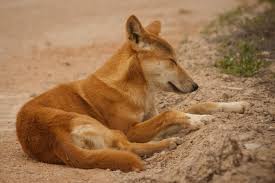
We met one of Australia’s most iconic animals- the dingo! These canines are really neat and we so enjoyed watching the ones we spotted!

dingo3

IMG_3686


Date: 4/18

Location: Great Victorian Desert

Dingo Fun Facts:

  • Dingoes are descendants of the Asian dingo. They are thought to have been introduced to Australia 3,000-4,000 years ago.
  • They can be solitary or found in packs.
  • Dingoes are the largest predator in Australia.
  • Dingoes in the desert are reddish-brown in color and are smaller than their cousin.

IMG_3687

  • Dingoes have excellent vision and can turn their heads about 180 degrees.
  • They have flexible wrist that gives them the ability to climb.
  • Dingoes do not bark, but they yodel/howl.

dingo2

dingo


Dingoes are quiet intelligent and often they are not loved by livestock farmers. They are predators you know! We think they are just the coolest!

Categories: adventure, Animals, Children, conservation, education, endangered species, mammals, nature, science, Today's Post, wildlife | Tags: , , , , , , , , | 1 Comment

Holy Marsupial Moley!

Holy Marsupial Moley!

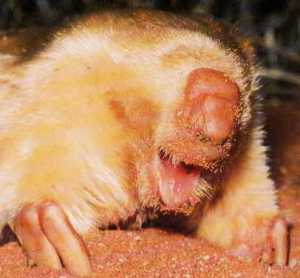
We’re back from spring break! Woohoo! We headed back to our camp at the edge of the desert and went exploring in the evening! We didn’t spot our animal today, but we did spot it’s track moving under the sand! The Southern Marsupial Mole is one neat and crazy animal!

mole

IMG_3672


Date: 4/17

Location: Great Victorian Desert

Southern Marsupial Mole:

  • Southern Marsupial moles have hard horny covering over their noses.
  • They have large claws for digging.
  • Its neck bones are fused together to protect it. 
  • They do not have working eyes, as they spend most of their time underground in the dark.
  • Southern Marsupial Moles are not related to other moles.
  • They do not dig permanent tunnels- just travel right under the sand surface. It is similar to “swimming” in sand.
  • Its silky fur keeps sand off of it. 


We had fun watching these little mysterious creatures under the sand. Can you imagine not having eyes because you live in darkness and they are not really useful?

Categories: adventure, Animals, Atlanta, Children, conservation, education, Environment, nature, Today's Post, wildlife | Tags: , , , , , , , , , | 1 Comment

Spring Break

Spring Break!

We’re off to the beach for the week! But make sure to check out our social media this week as we have some great animal friends who are taking over! Woohoo!

e e beach

Categories: adventure, Animals, Children, conservation, education, entertainment, Environment, nature, science, Today's Post, wildlife | Tags: , , , , , , , | 1 Comment

A Skink not a Skunk!

A Skink not a Skunk!

After we settled in at camp we decided where we should go on our first adventure! We wanted to meet a neat little lizard we knew lived in this habitat! We headed off for the day with our day packs full of snacks and MUD SPF 30 sunscreen!

great desert skink

IMG_3315


Date: 4/3

Location: Great Victorian Desert

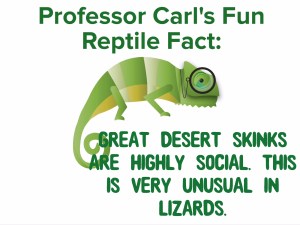
Great Desert Skink Fun Facts:

  • Great desert skinks vary in color from tan to grey or dark brown.
  • They store fat in their tales during the winter.
  • Males are slightly larger than females.
  • Great desert skinks live in complex burrows with several entrances and areas.

IMG_3316

  • A family group occupies the burrow. Babies stay with their family for up to three years.
  • They generally hunt at night in the hotter months.

great desert skink2

We had such fun going to look for these little short legged lizards! They remind us of another Australian skink- the blue tongued skink! They are both so cool! And they aren’t slimy at all- very smooth!

Categories: adventure, Animals, Children, conservation, education, endangered species, Environment, nature, reptiles, Today's Post, wildlife | Tags: , , , , , , , , , , | 1 Comment

Desert Down Under

Desert Down Under

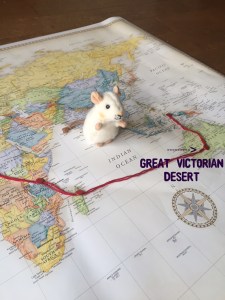
We have backed our bags again and headed off to the great island nation of Australia! It is a long way from HQs. We unpacked at camp just at the edge of the Great Victorian Desert. After getting over our jet lag. We set out to learn more about this vast and interesting habitat!

IMG_3317

Great Victorian Desert Fun Facts:

  • It is the largest desert in Australia.  It’s about 135,000 square miles.
  • It is located in the Southwest of Australia.
  • Temps can range from 104 degree Fahrenheit in summer to 64 in the winter.
  • The Mamungari Conservation Park lies within the Great Victorian Desert.

e e desert

  • Only very hard plants survive in the desert, but there is a great variety of plants.
  • There is quiet a variety of animals in the desert that are adapted to live in the harsh environment!

great victorian desert

We are super excited to meet some of the inhabitants of this great desert! We’ll be meeting an interesting lizard tomorrow! See you then!


Categories: adventure, Animals, Children, conservation, education, Environment, nature, science, Today's Post, wildlife | Tags: , , , , , , , , , | 1 Comment

Blog at WordPress.com.